
Today’s DOTD - Drink Of The Day - is a Lawbreaker Cocktail inspired by the speed limit being lowered by the federal government to 55 mph.
It happened on this day, January 2, 1974, that then-President Richard Nixon signed the Emergency Highway Energy Conservation Act. His bill was a response to the 1973 OPEC-caused oil crisis, also known as the Yom Kippur War, yet another of the Arab-Israel wars of the 20th Century. Because of the war, from October 1973 to March 1974, the price of a barrel of oil went from $3 to $12, which caused a severe shortage, and spurred the bill.
Unfortunately, the EHECA also contained the NMSL, the National Maximum Speed Limit, which lowered the speed limit on all U.S. roads to a maximum of 55 miles per hour. It was a dire time for anyone hoping to reach their destination in a single lifetime, even if Sammy Hagar had a big hit with his song I Can’t Drive 55 which hit the charts in 1984.
Prior to 1974, the power to set speed limits was considered a 10th Amendment issue, the sole exception to this occurring during World War II, when the U.S. Office of Defense Transportation established a national maximum “Victory Speed Limit” of 35 miles per hour to help conserve fuel and rubber for the war effort. The Victory Speed Limit lasted from May 1942 to August 14, 1945, when the war ended, though it was often disregarded.
Immediately before the NMSL became effective in 1974, speed limits varied across the U.S., with some as high as 75 or 80 mph, like in Kansas. At that time, Montana & Nevada generally posted no speed limits on highways, limiting drivers to only whatever was safe for conditions. This was all well and good when industrialized nations like the U.S. enjoyed easy access to cheap Middle Eastern oil. But things changed dramatically in 1973 with the Arab-Israeli conflict. Arab members of OPEC were not too keen on the West’s support of Israel in the Yom Kippur War and decided to stop oil shipments to the U.S., Japan, and Western Europe.
This, of course, caused problems. Europe and the U.S. both fell into recession. The oil shortage led Nixon to propose a national 50 mph speed limit for cars and 55 mph for trucks and buses. He somehow believed that cars were most efficient from 40-50 mph while trucks were so at 55 mph. This idea of differential speed limits was opposed by the largest trucking association. They pointedly advised that differential speed limits were “not wise from a safety standpoint.” Congress agreed with the truckers, and set the NMSL to 55 for all vehicles.
Nixon signed the Emergency Highway Energy Conservation Act on January 2, 1974 and states had to comply if they wanted federal money for highway construction and maintenance.
Compliance with the law by motorists was, shall we say, low. In 1982 New York monitored their highways and noted 83% noncompliance. Connecticut found 88% noncompliance. Various states began taking the teeth out of the law by reducing fines for noncompliance to trivial amounts. By 1981, 33 state legislatures debated ways around the law.
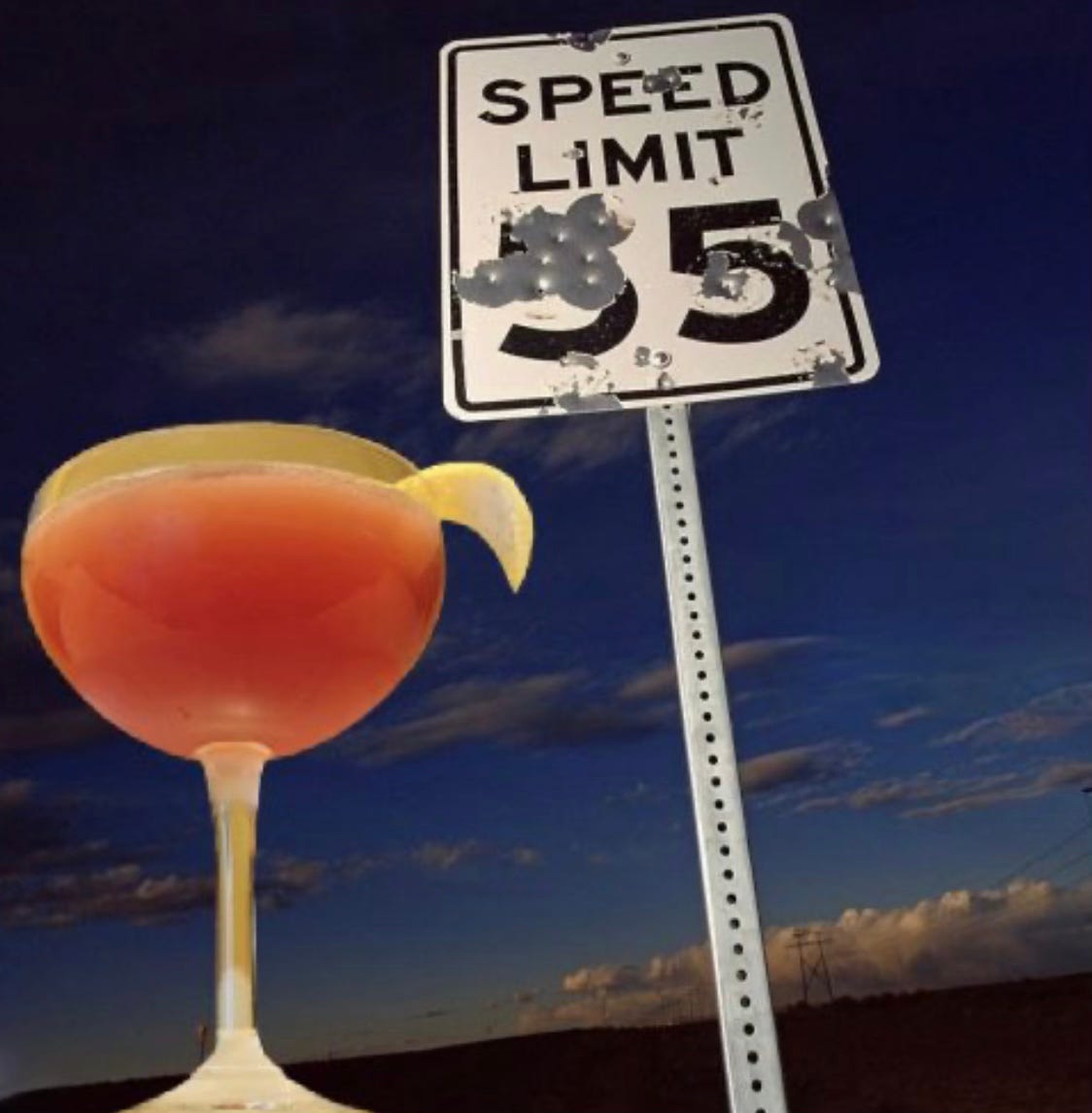
Still, it took until December 1995 for Congress to officially pass a new law that lifted federal speed limit controls beyond 55 mph - meaning that, effectively, for 21 years, from 1974 to 1995, most Americans who drove on the highways & byways of the nation, were lawbreakers.
This cocktail is for all those who make good trouble, and break stupid pointless laws. So raise a glass of today’s Drink Of The Day, the Lawbreaker Cocktail, to anyone you know who falls into that category - including you!
Ingredients
Here’s what you’re going to need for this drink:
