
Today’s DOTD - Drink Of The Day - is a Burning Bright Cocktail, inspired by the holiday of Juneteenth, of course! A federal holiday since 2021, Juneteenth occurs on June 19th every year., and is considered the longest-running African American holiday in the U.S.
The Historical Legacy of Juneteenth
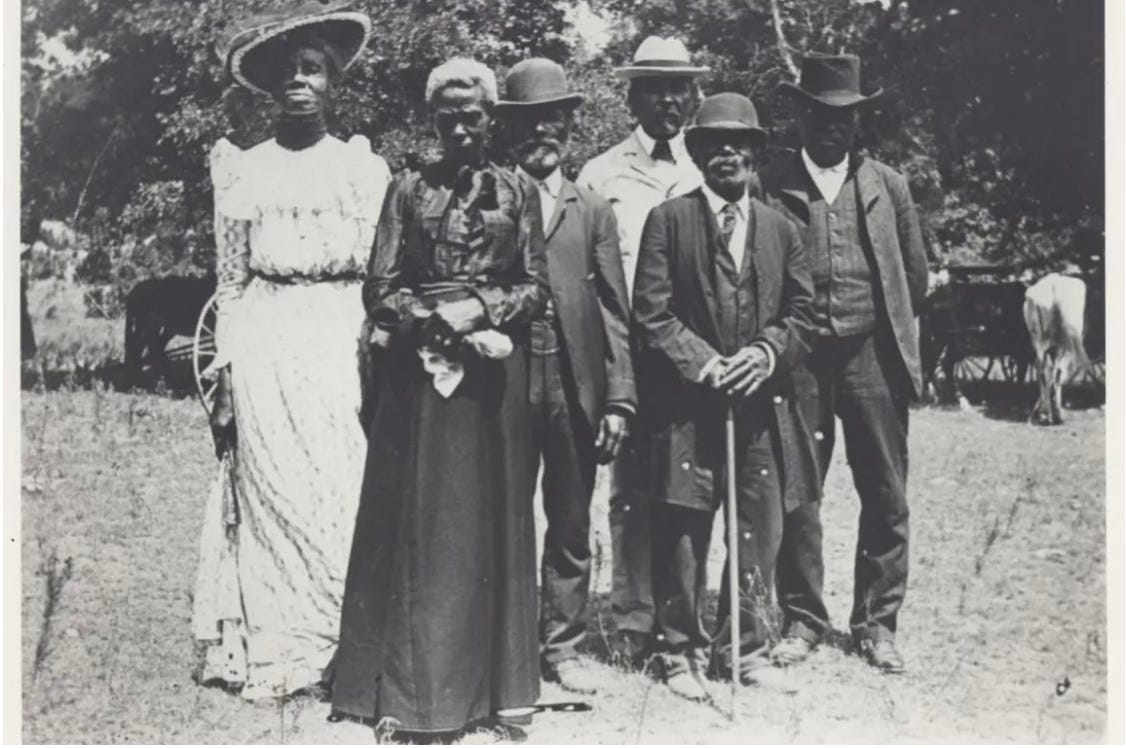
Emancipation Day celebration, June 19, 1900, held in “East Woods” on East 24th Street in Austin, Texas. Credit: Austin History Center.
For those who are unfamiliar with this day & its history, Juneteenth - also known as Freedom Day or Emancipation Day - is an annual holiday commemorating the day enslaved African Americans in Texas were finally freed from slavery.
More specifically, Juneteenth marks the date in 1865 when Union soldiers arrived in Galveston, Texas, to announce that the Civil War had ended and that all enslaved people were free - a fact that had been kept from the enslaved people of Texas by the pro-Confederate residents for almost two years.
Freedom’s Eve, Watch Night, & A Crucial Delay
During the heat of the U.S. Civil War, in 1862, President Abraham Lincoln issued an ultimatum to the traitors of the United States, in the Confederate-held territories. Lincoln issued the preliminary Emancipation Proclamation on September 22, 1862, following the decisive win by Union forces at the Battle of Antietam. that proclamation declared that slaves in all states still rebelling 100 days later, on January 1, 1863, would be freed, unless the Confederacy laid down its arms and rejoined the Union by the start of the new year. The traitors in the South refused.
So on the eve of January 1, 1863, also known as “Freedom’s Eve,” enslaved and free African Americans gathered in churches and private homes all across the country, don an evening known as “Watch Night,” awaiting news that Lincoln’s Emancipation Proclamation had taken effect. At the stroke of midnight, their prayers were answered, as all enslaved people across the United States - including in the Confederate-held states - were declared legally free.
The next day, Union soldiers, many of whom were black, marched onto plantations and across cities in the South, reading aloud to groups of slaves from small copies of the Emancipation Proclamation, and spreading the news of freedom to the Confederate-held states.
Understanding the Significance of June 19, 1865
Unfortunately, not everyone in the U.S. would immediately be free. Even though the Emancipation Proclamation was made effective on January 1, 1863, it could not be implemented in places still under Confederate control. As a result, in the westernmost Confederate-controlled state of Texas, enslaved people would not be free until much later.
In fact, while Confederate General Robert E. Lee surrendered at Appomattox Court House, Virginia in April 1865, officially ending the U.S. Civil War, slavery remained relatively intact in Texas as the state had been largely untouched by the war and had avoided Union military occupation. In fact, many former slavers from elsewhere in the South had moved to Texas, specifically to continue their ownership of other human beings.
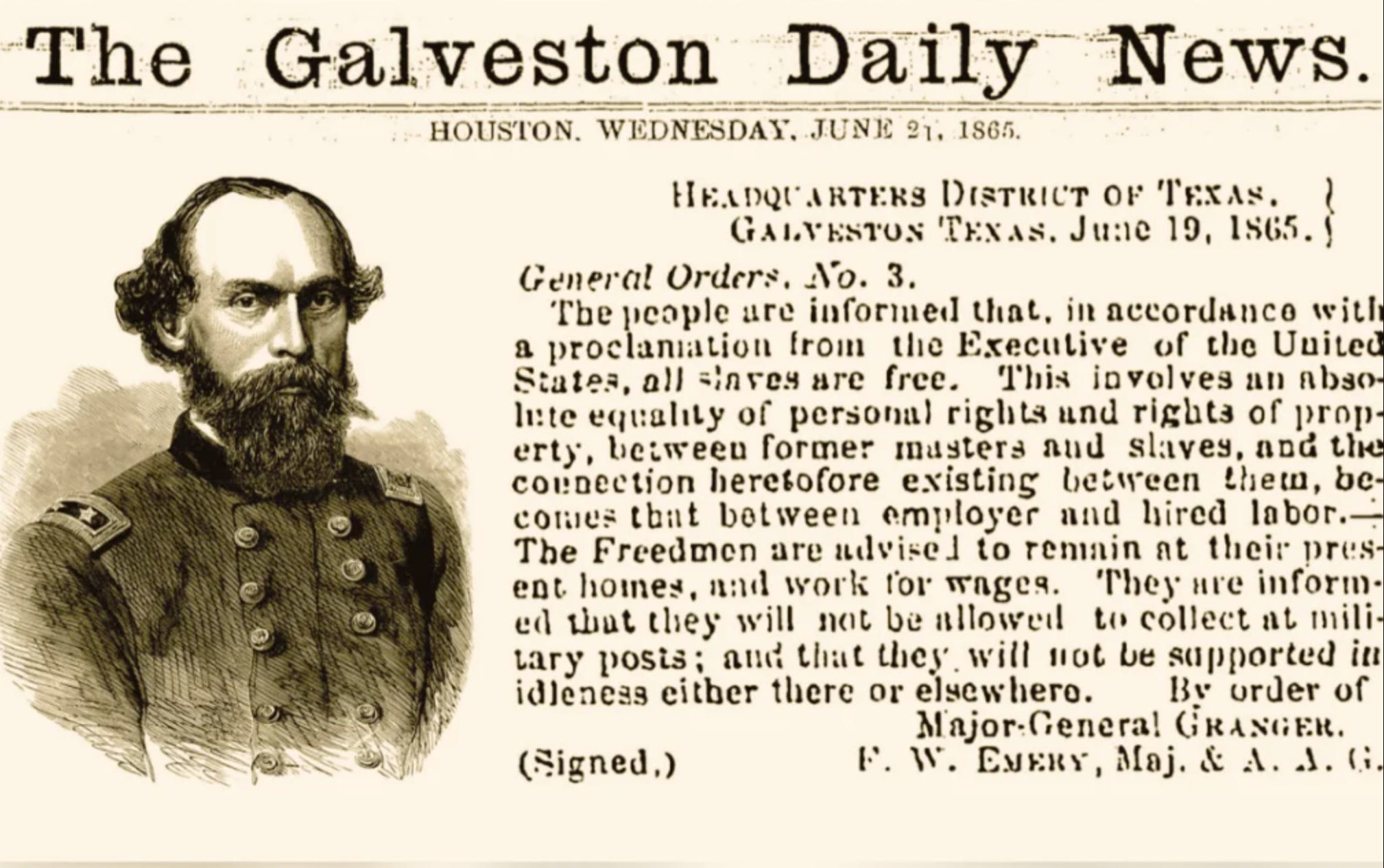
Freedom finally came to Texas though on June 19, 1865. That’s when General Gordon Granger, Under orders from Maj. Gen. Philip H. Sheridan, arrived in Galveston Bay, Texas, along with some 2,000 Union troops. Granger was charged with bringing Texas to heel under United States federal control. Granger began his tenure in Texas on June 19, 1865 by issuing five General Orders, the most famous of which was General Order No. 3 which stated the following:
“The people of Texas are informed that, in accordance with a proclamation from the Executive of the United States, all slaves are free. This involves an absolute equality of personal rights and rights of property between former masters and slaves, and the connection heretofore existing between them becomes that between employer and hired labor….”
General Order No. 3 brought Black freedom to Texas two-and-a-half years after it had been issued by Pres. Lincoln. As a result of the order, jubilant celebrations erupted in Galveston and rippled across Texas as the news of the Union’s military occupation and enforcement measures swept the Lone Star state. Granger and his U.S. Army troops continued to spread the word that the more than 250,000 enslaved Black people in the state of Texas were, like all other enslaved people in the U.S., free by executive decree. This day came to be known as “Juneteenth,” by the newly freed people in Texas, and was a key moment in the Reconstruction era.

Reflections on Emancipation and Reconstruction
The post-emancipation period known as Reconstruction (1865-1877) marked an era of great hope, uncertainty, and struggle for the nation as a whole. Formerly enslaved people immediately sought to reunify families, establish schools, run for political office, push radically progressive legislation, and even sue slaveholders for compensation.
Given the 200+ years of enslavement at that point in time, such vast & rapid changes were nothing short of amazing. Not even a generation out of slavery, African Americans were inspired and empowered to transform their lives and their country.
Juneteeth - A Celebration of Freedom
Juneteenth marks our country’s second independence day. Although it has long been celebrated in the African American community, this monumental event remains largely unknown to many Americans, though that’s changing as more Americans become aware of historical facts they were never previously taught.

The historical legacy of Juneteenth shows the value of never giving up hope in uncertain times. We thank the National Museum of African American History and Culture in Washington, DC for much of the history we’re using here today.
And now, let’s raise a glass in salute with today’s Drink Of The Day, a Burning Bright Cocktail!
Ingredients
Here’s what you’re going to need for this drink:
