
DOTD For Monday, March 2, 2026
With News Of Lies, War, And All, You Need A Great Drink, In A Highball
Today’s DOTD - Drink Of The Day - is a Dartmouth Highball inspired by the birthday of famous Dartmouth College grad, & legendary children’s writer and illustrator, Dr. Theodor Seuss Geisel, better known to the world as Dr. Seuss! He was born on March 2, 1904, in Springfield, Massachusetts.
Early career and first Dr. Seuss books
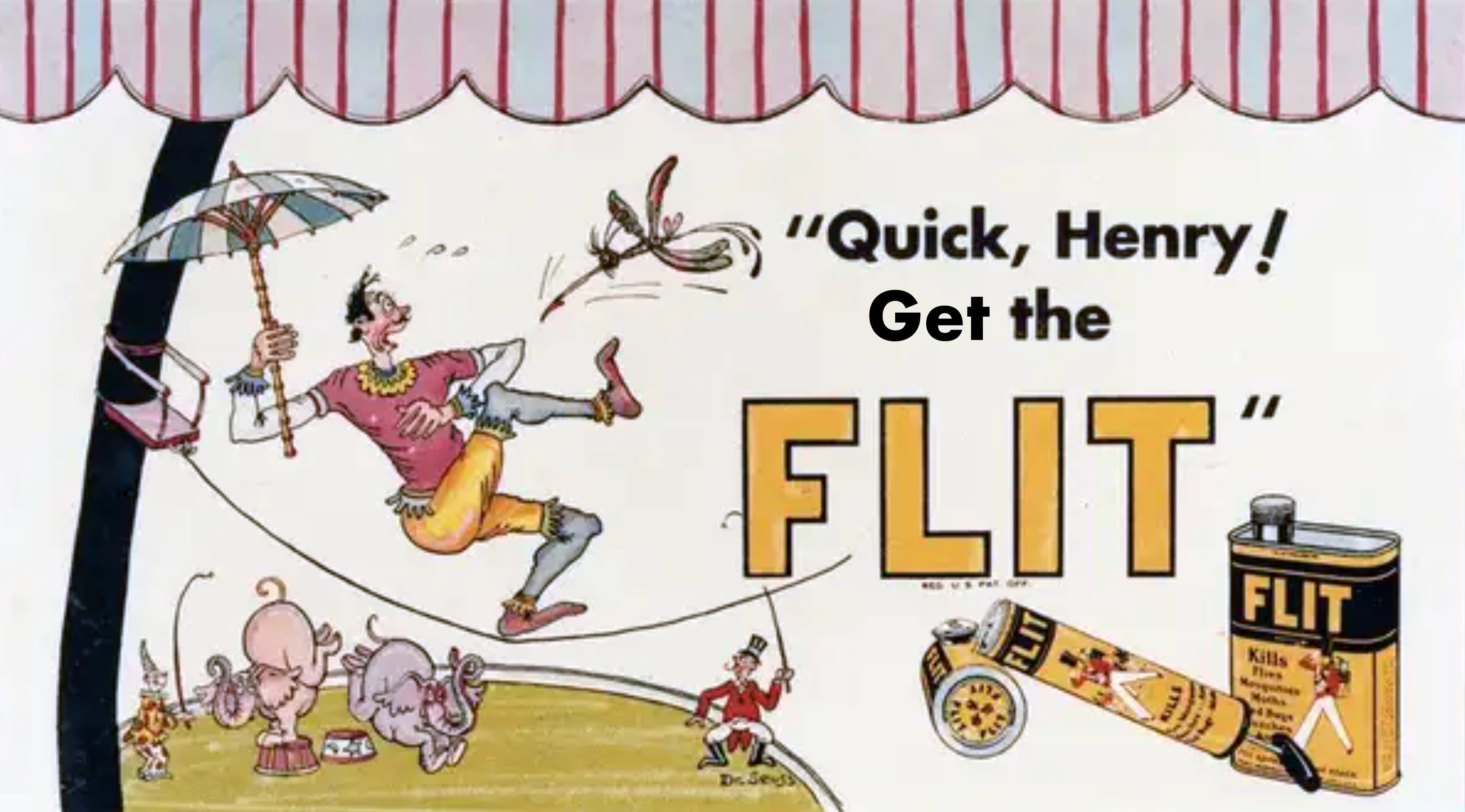
After graduating from Dartmouth College (B.A., 1925), Geisel did postgraduate studies at Lincoln College, Oxford, and at the Sorbonne. He subsequently began working for Life, Vanity Fair, and other publications as an illustrator and humorist. In addition, he found success in advertising, providing illustrations for a number of campaigns. Geisel was especially noted for his work on ads for Flit insect repellent. Some of his characters later appeared in his children’s works
After illustrating a series of humor books, Geisel decided to write a children’s book, which was reportedly rejected by nearly 30 publishers. After his chance meeting with a friend who was an editor at Vanguard Press, And to Think That I Saw It on Mulberry Street was finally released in 1937. The work centers on a young boy who transforms his ordinary walk home from school into a fantastical story. Later, however, he describes only the facts of his walk to his father, who frowns on the boy’s imaginative nature. Geisel used the pen name Dr. Seuss, planning to publish novels under his surname; the Dr. was a tongue-in-cheek reference to his uncompleted doctorate degree. However, his first book for adults, The Seven Lady Godivas (1939), fared poorly, and thereafter he focused on children’s books, which he preferred to write. In many profiles and articles, he’s often quoted as having said, “Adults are obsolete children, and the hell with them.” In 1986 he published a humor book on aging “for readers of all ages,” You’re Only Old Once! A Book for Obsolete Children.
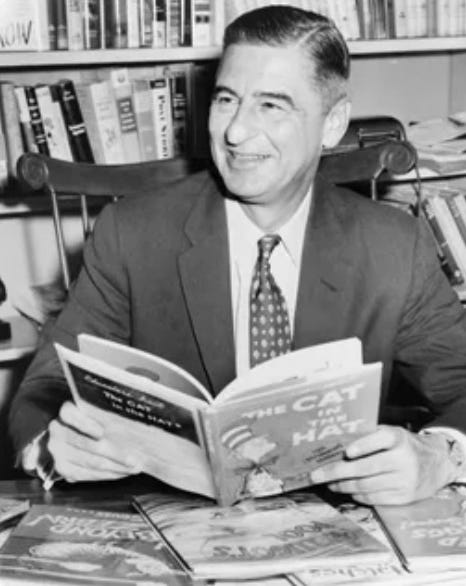
After publishing several more children’s works, Geisel released Horton Hatches the Egg in 1940. With it, he introduced the features that would come to define his books: A unique brand of humor, playful use of words, and outlandish characters. It centers on an elephant who is duped into sitting on the egg of a bird who goes on vacation. Despite various hardships, Horton refuses to leave: “I meant what I said, and I said what I meant. An elephant’s faithful, one hundred percent!” In the end, Horton is rewarded when the egg hatches, and a creature with bird wings and an elephant’s head emerges.
During World War II, Geisel’s focus shifted to politics. In the early 1940s, he was an editorial cartoonist at PM magazine in New York City. Although his political cartoons pointedly critiqued American isolationism and “America First” attitudes, some of them also contained xenophobic and sexist tropes and racist depictions of Asians (in particular, Japanese people), Arabs, and Africans. Geisel then served (1943–46) in the U.S. Army, where he was assigned to the documentary division. In 1945, he wrote Your Job in Germany, which was directed by Frank Capra; it was later remade as the Academy Award-winning Hitler Lives (1945), though Geisel was not credited. After his service ended, he continued to make films. With his first wife, Helen Palmer Geisel, he wrote the Oscar-winning documentary feature Design for Death (1947). His animated cartoon Gerald McBoing-Boing (1950) also won an Academy Award.
The Cat in the Hat, How the Grinch Stole Christmas!, and other classics of Dr. Seuss
In 1947, after the war, Geisel returned to children’s books with McElligot’s Pool, about a boy who imagines a fantastical marine world while fishing. The work was especially noted for Geisel’s inventive creatures, which would come to populate his later stories. In addition, he continued to use his whimsical rhymes to convey important life lessons. In Horton Hears a Who! (1954), the loyal pachyderm returns to protect a tiny speck of a planet known as Whoville. A discussion about minority rights and the value of all individuals, the work features Horton repeating “a person’s a person, no matter how small.” The book’s message was inspired by Geisel’s visit to Japan in 1953, where the devastation of the 1945 atomic bombing of Hiroshima deeply affected him and caused him to retract some of his previous anti-Japanese views. He also published The Sneetches (1953), which tackles racism.
In 1957 Geisel published two of his most popular works: The Cat in the Hat and How the Grinch Stole Christmas!.
Scene from the 1966 classic “How The Grinch Stole Christmas!”
The former features a mischievous talking cat who entertains two bored children on a rainy day, while the latter introduces the Scrooge-like Grinch, who wants to ruin Christmas in Whoville but ultimately discovers that the holiday is more than just its material trappings. How the Grinch Stole Christmas! was later adapted (1966) for television, and it became a holiday staple. It was also made into a feature film (2000), a Broadway musical (2006), and an animated movie (2018).
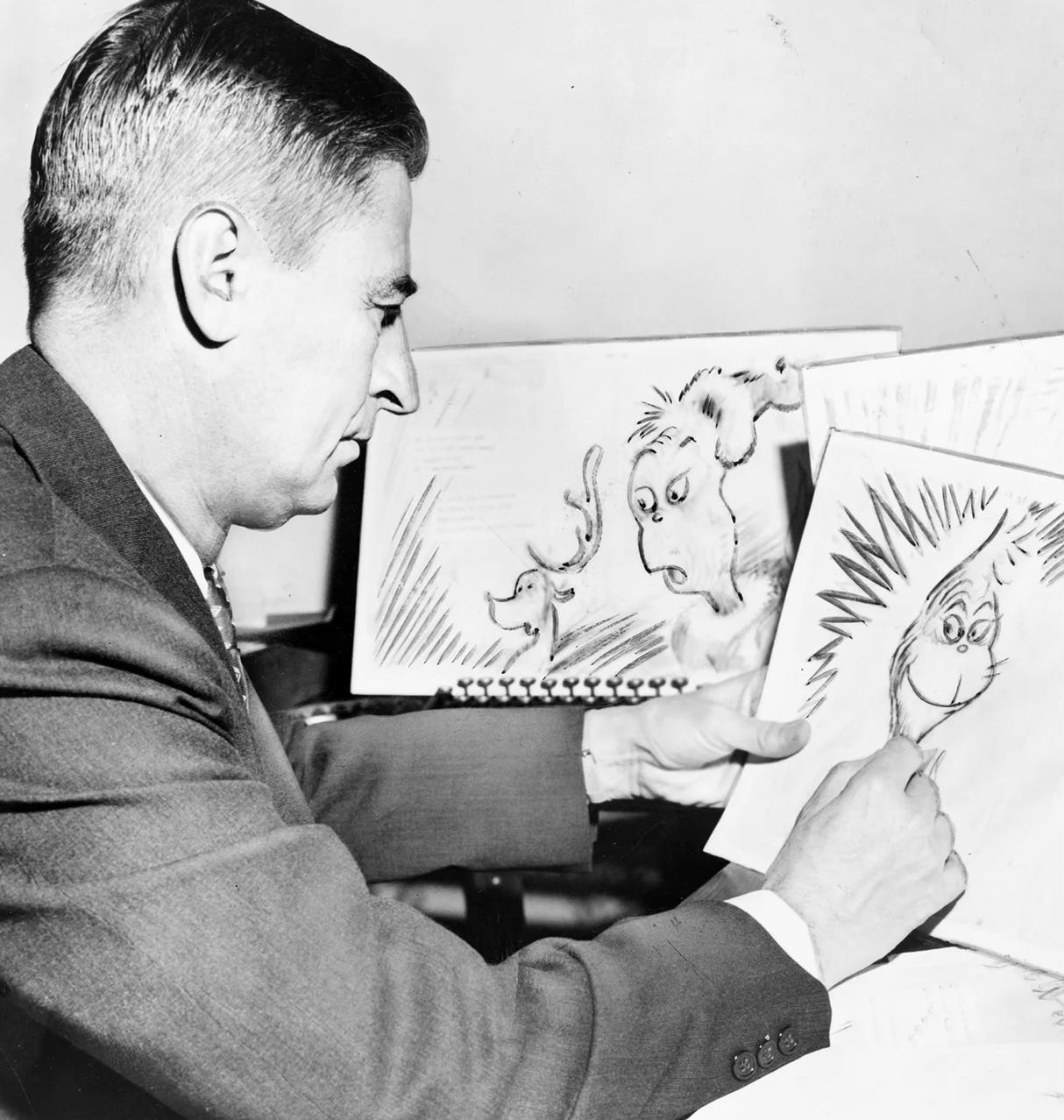
In 1958, Geisel founded Beginner Books, Inc., which in 1960 became a division of Random House. He subsequently wrote a number of books for beginning readers, notably One Fish Two Fish Red Fish Blue Fish (1960), Green Eggs and Ham (1960), Hop on Pop (1963), and Fox in Socks (1965). They—along with his other works—went far beyond the traditional, and often boring primers, and were valued for their contribution to the education of children. During this period, Geisel also wrote The Lorax (1971), in which he expressed concern for the environment. The cautionary tale centers on a businessman who destroys a forest of Truffula trees—despite the protest of the Lorax, who speaks up because “the trees have no tongues”—and, when left with a desolate landscape, laments the damage he has caused. Geisel’s later notable books include the inspirational Oh, the Places You’ll Go!(1990), which became a popular graduation gift to students.
In 1984, Geisel received a Pulitzer Prize “for his special contribution over nearly half a century to the education and enjoyment of America’s children and their parents.” The honor underscored the immense popularity of his works, which were perennial best sellers. According to various reports, by the early 21st century more than 600 million copies of Dr. Seuss books had been sold worldwide.

In 1948, Geisel moved to La Jolla, California, where he lived until his death in 1991. He annually conducted a children’s workshop at the La Jolla Museum of Art. A large collection of his papers was housed at the University of California, San Diego. The university’s library was renamed the Geisel Library in his honor in 1995. Two years later, the National Education Association (NEA) partnered with Dr. Seuss Enterprises to launch a youth literacy initiative, Read Across America. The following year saw the first Read Across America Day, on March 2, in honor of Geisel’s birthday. The event has been held annually on or near his birthday ever since.
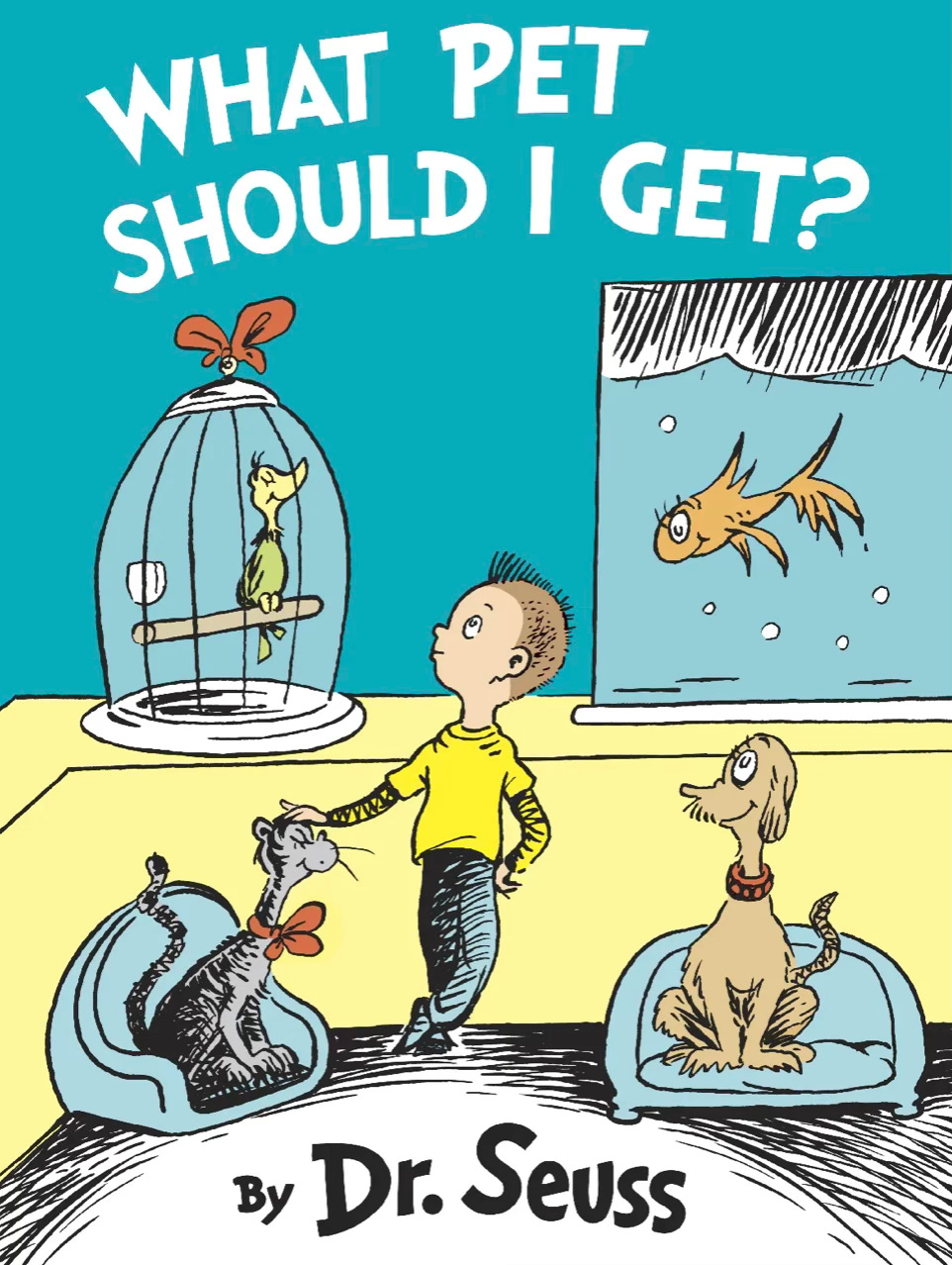
In 1999 more than 200 of Geisel’s political cartoons made during World War II were collected and published by history professor Richard H. Minear in the book Dr. Seuss Goes to War. Some of Geisel’s early tales for children were posthumously collected as The Bippolo Seed, and Other Lost Stories (2011) and Horton and the Kwuggerbug, and More Lost Stories (2014). The book What Pet Should I Get?, discovered by his widow in 2013, was published in 2015.
Other Work & Honors
Geisel also designed and produced animated cartoons for television, many of them based on his books, and he won Emmy Awards for Halloween Is Grinch Night (1977) and The Grinch Grinches the Cat in the Hat (1982). In addition, several more of his books were adapted as feature films in the 21st century.
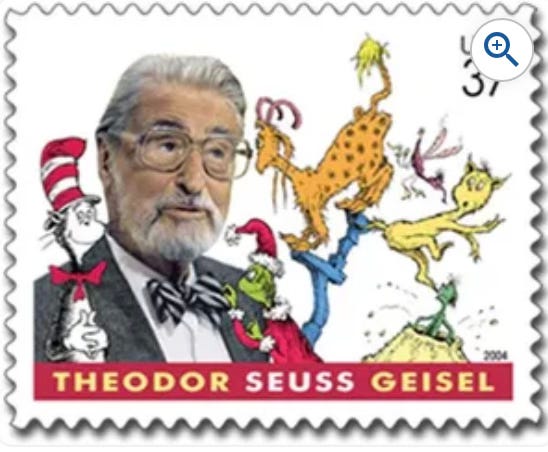
He was also honored with his own stamp, as the U.S. Postal Service issued a 37-cent commemorative stamp honoring Dr. Seuss (Theodor Seuss Geisel) on March 2, 2004. Released on his 100th birthday in La Jolla, California, the stamp features Seuss with characters like the Cat in the Hat and the Grinch.
Controversies
Despite the messaging of tolerance and diversity in some of Geisel’s children’s books, a number of them have been challenged in the 21st century for their racist stereotypes of Asian, Arab, and Black people. These include books published before his career as a political cartoonist and after his visit to Japan in 1953, which had inspired his The Sneetches and Horton Hears a Who!.
His first children’s book, And to Think That I Saw It on Mulberry Street, features illustrations with anti-Asian stereotypes and depicts a circus ringmaster holding a whip over both an elephant and its African driver. Some modern readers have also argued that there are racial elements in The Cat in the Hat, viewing the Cat’s white gloves and appearance as a representation of blackface minstrelsy. This argument also claims that this depiction was inspired by Annie Williams, a Black elevator operator at Geisel’s publisher Houghton Mifflin who wore white gloves.
These problematic elements led a number of organizations, including the NEA and its initiative Read Across America, to distance themselves from highlighting Geisel’s work. (However, Read Across America Day is still held on March 2.) In addition, in 2021 Dr. Seuss Enterprises announced that it would no longer publish or license six of his books, including And to Think That I Saw It on Mulberry Street, citing its “hurtful and wrong” portrayals of people.

There are those who believe Dr. Seuss should be viewed in his full context however, and who think that his maturation and growth should be viewed even more positively, as his shift from casual racism to a a solid advocate for diversity shows that people can change and improve throughout their life.
With that in mind, we salute one of our favorite Dartmouth grads, Dr. Seuss, with today’s Drink of the Day, the Dartmouth Highball.
Ingredients
Here’s what you’re going to need for this drink:
