
DOTD For Thursday, April 16, 2026
A Salute To A True Hollywood Liberal - And A Target Of Fascists Everywhere
Today’s DOTD - Drink Of The Day - is a Charlie Chaplin Cocktail inspired by the birthday of legendary actor Charlie Chaplin!
Charles Spencer Chaplin Jr. was born in London, England, on April 16th, 1889. His father Charles Sr. was a versatile vocalist and actor; and his mother Hannah, known under the stage name of ‘Lily Harley,’ was an attractive actress and singer, who gained a reputation for her work in the light opera field.
Unfortunately for Charlie, his childhood was marked by poverty and hardship. From severe poverty, through the mental & physical health problems of both his parents, to the early death of his father due to severe alcoholism when Charlie was just 10, his childhood was anything but easy.
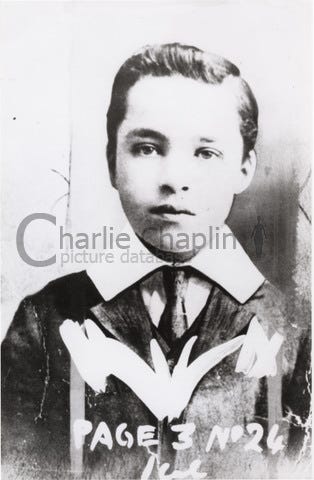
Throughout these years, Charlie and his older brother, Sydney, took to fending for themselves. Having inherited natural talents from their parents, both youngsters took to the stage as the best opportunity for a career that might get them out of the workhouses & poor schools. By the time he was 10, Charlie made his professional debut as a member of a juvenile group called “The Eight Lancashire Lads” and rapidly won popular favor as an outstanding tap dancer.
Beginning of his career
When he was about twelve, Chaplin got his first chance to act in a legitimate stage show, and appeared as “Billy” the page boy, in support of first H. A. Saintsbury, and then William Gillette, in different productions of “Sherlock Holmes”. At the close of this engagement, Charlie started a career as a comedian in vaudeville, which eventually took him to the United States in 1910, as a featured player with the Fred Karno Company.
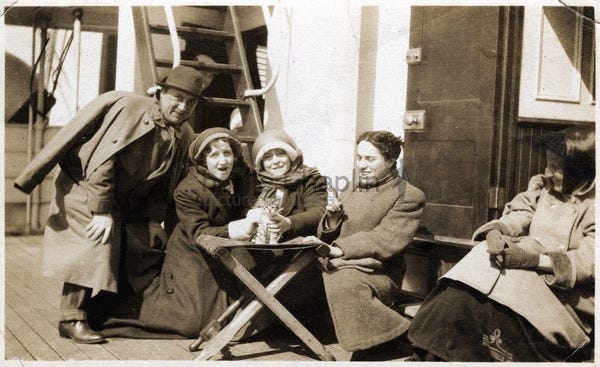
He scored an immediate hit with American audiences, particularly with his characterization in a sketch entitled “A Night in an English Music Hall”. When the Fred Karno troupe returned to the United States in the fall of 1912 for a repeat tour, Chaplin was offered a motion picture contract.
He agreed to appear before the cameras at the expiration of his vaudeville commitments in November 1913, and his start in the film world began that month when he joined Mack Sennett and the Keystone Film Company - yes, that Keystone Film Company, home of the fictional, humorously incompetent policemen known as the Keystone Cops, a hallmark of the early silent film industry.
The Cops would go on to become supporting actors to big stars like Chaplain. And Chaplain was becoming a big star. His initial salary was $150 a week - $4,951.29 per week in 2026 dollars - but his overnight success on the screen spurred other producers to start negotiations for his services.
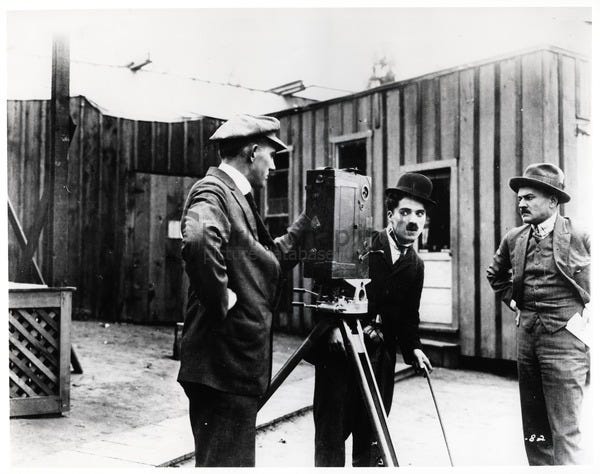
At the completion of his Keystone contract, Chaplin moved on to the Essanay Company in 1915, with a large boost to his salary. By this point, his brother Sydney Chaplin had arrived in the U.S. from England, and took Charlie’s place with Keystone as their leading comedian.
The following year Charlie was even more in demand and signed with the Mutual Film Corporation for a much larger sum to make 12 two-reel comedies, most as his legendary character “The Tramp.”
Gaining independence
When his contract with Mutual expired at the end of 1917, Chaplin began to look for more freedom and control in making his movies. Early in 1918, Chaplin entered into an agreement with First National Pictures.
Even though Chaplain was one of First National’s top producing talents, he couldn’t get them to increase his production budgets. Other major stars of the time, Mary Pickford and Douglas Fairbanks, were having similar problems with their studios - and the three top stars began to talk. Sydney Chaplin, brother and business manager for Charlie, deduced something sinister was going wrong, and together they hired a private detective, who discovered a plan between the studios to merge all production companies and to lock in “exhibition companies” to a series of five-year contracts - and to cut stars out of the deals.
This lead to the foundation of the United Artists Corporation by Chaplain, Pickford, Fairbanks, and legendary film director D.W. Griffth in April 1918. Historian B.B. Hampton, in his “History of the Movies” says:
“The corporation was organized as a distributor, each of the artists retaining entire control of his or her respective producing activities, delivering to United Artists the completed pictures for distribution on the same general plan they would have followed with a distributing organization which they did not own. The stock of United Artists was divided equally among the founders. This arrangement introduced a new method into the industry. Heretofore, producers and distributors had been the employers, paying salaries and sometimes a share of the profits to the stars. Under the United Artists system, the stars became their own employers. They had to do their own financing, but they received the producer profits that had formerly gone to their employers and each received his share of the profits of the distributing organization.”
After the founding of United Artists, Chaplain’s career continued to grow But first, there was some unfinished business to take care of.
The Kid (1921)
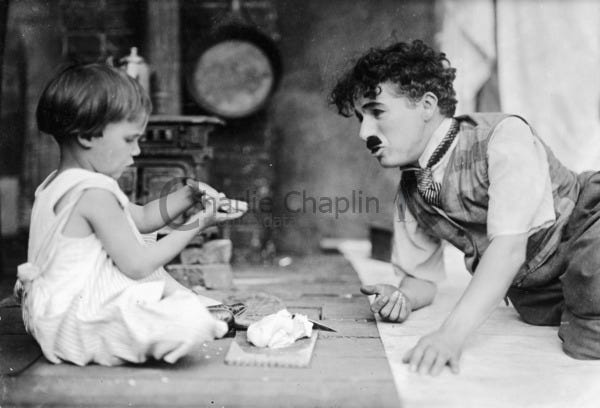
Before he could assume his full responsibilities with United Artists, Chaplin had to complete his contract with First National. So early in 1921, he came out with a six-reel masterpiece: The Kid, in which Chaplain introduced to world the then-child actor Jackie Coogan, who became one of the first child stars of film. Coogan made millions playing kids in the silent film era, but his parents squandered all of his money. Their failure led to California enacting the California Child Actor’s Bill, widely known as the “Coogan Act”
Later in 1921, Chaplain released “The Idle Class”, in which he portrayed a dual character. Then, feeling the need for a complete rest from his motion picture activities, Chaplin sailed for Europe in September 1921. London, Paris, Berlin and other capitals on the continent gave him tumultuous receptions. After an extended vacation, Chaplin returned to Hollywood to resume his picture work and start his active association with United Artists.
What follows are a few of the best pictures Chaplain made in the second half of his career, though you can view all of these - what he called his “Masterpiece Features” here.
The Circus (1928)
The Circus won Charlie Chaplin his first Academy Award – it was still not yet called the ‘Oscar’ when he was given it at the first presentations ceremony, in 1929. But as late as 1964, it seemed, this was a film he preferred to forget. The reason was not the film itself, but the deeply fraught circumstances surrounding its making.
While the film was a comedy, his personal life was anything but. Chaplin was in the throes of the break-up of his marriage with Lita Grey, and production of The Circus coincided with one of the most unseemly and sensational divorces of 1920’s Hollywood, as Lita’s lawyers sought every means to ruin Chaplin’s career by smearing his reputation. At the height of the legal battle, production of The Circus was brought to a total halt for eight months, when her lawyers sought to seize the studio assets. Chaplin was forced to smuggle the parts of the film that were already shot to safe hiding.
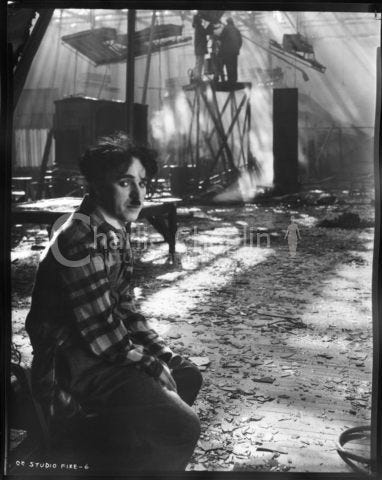
As if his domestic troubles were not enough, the film seemed fated to catastrophe of every kind. Even before shooting began, the huge circus tent which provides the principal setting for the film was destroyed by gales. After four weeks of filming, Chaplin discovered that bad film development work had made everything already shot unusable. In the ninth month of shooting, a fire raged through the studio, destroying sets and props.
When the film unit finally returned to work after the eight month legal pause, they found that Hollywood’s exploding real-estate development had, in the meantime, transformed the location scenery they’d used before completely beyond recognition. The troubles persisted to the very end. For the final scene, of The Circus moving out of town, the wagons were towed to the filming location. When the unit returned for the second day’s shooting, the whole circus train had vanished. It had been stolen by some high-spirited students who planned to use it for a marathon bonfire. This time, luckily, Chaplin was just in time to prevent the catastrophe. Somehow, from all the chaos, Chaplin conjured a film of deft comedy and admirable structure.
City Lights (1931)
City Lights proved to be the hardest and longest undertaking of Chaplin’s career. By the time it was completed he had spent two years and eight months on the work, with almost 190 days of actual shooting. The marvel is that the finished film betrays nothing of this effort and anxiety.
Even before he began City Lights, the sound film was firmly established. This new revolution was a bigger challenge to Chaplin than to other silent stars. His Tramp character was universal. His mime was understood in every part of the world. But if the Tramp now began to speak in English, that world-wide audience would instantly shrink.
Chaplin boldly solved the problem by ignoring speech, and making City Lights in the way he had always worked before, as a silent film. However he astounded the press and the public by composing the entire score for City Lights.
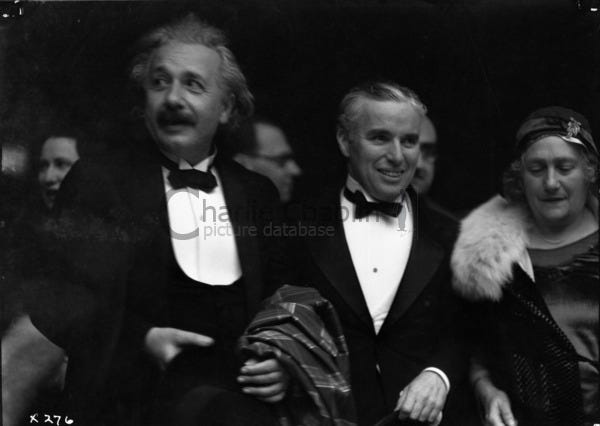
The premieres were among the most brilliant the cinema had ever seen. In Los Angeles, Chaplin’s guest was Albert Einstein; while in London, Bernard Shaw sat beside him. City Lights was a critical triumph. All Chaplin’s struggles and anxieties, it seemed, were compensated by the film which still appears as the zenith of his achievement and reputation.
Modern Times (1936)
Modern Times marked the last screen appearance of the Little Tramp - the character which had brought Charlie Chaplin world fame, and who still remains the most universally recognized fictional image of a human being in the history of art.
The world from which the Tramp took his farewell was very different from that into which he had been born, two decades earlier, before the First World War. Then he had shared and symbolized the hardships of all the underprivileged of a world only just emerging from the 19th century. Modern Times found him facing very different predicaments in the aftermath of America’s Great Depression, when mass unemployment coincided with the massive rise of industrial automation.
Chaplin was acutely preoccupied with the social and economic problems of this new age. In 1931 and 1932, he had left Hollywood behind, to embark on an 18-month world tour. In Europe, he had been disturbed to see the rise of nationalism and the social effects of The Great Depression, of unemployment and of automation.
He read books on economic theory; and devised his own ‘Economic Solution,’ an intelligent exercise in utopian idealism, based on a more equitable distribution not just of wealth but of work. In 1931, he told a newspaper interviewer, “Unemployment is the vital question . . . Machinery should benefit mankind. It should not spell tragedy and throw it out of work”.
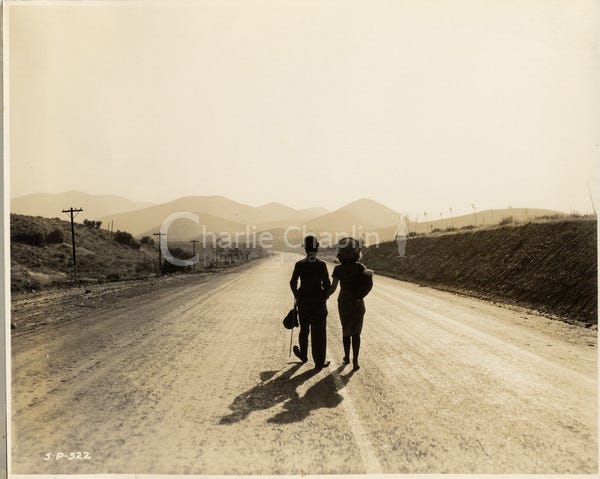
In Modern Times Chaplin set out to transform his observations and anxieties into laughter. This comedic masterpiece finds the iconic Little Tramp (Charlie Chaplin) first employed at a state-of-the-art factory where the inescapable machinery completely overwhelms him. Throughout the film, various mishaps keep getting him sent to prison. In between his various jail stints, he meets and befriends an orphan girl (Paulette Goddard). Both together and apart, they try to contend with the difficulties of modern life, with the Tramp eventually working as a singing waiter. In the end, he & the girl find each other again, and end up walking down a lonely road, ready to face whatever the future may bring, together.
The Great Dictator (1940)
When writing The Great Dictator in 1939, Chaplin was as famous worldwide as Hitler, and his Tramp character wore the same mustache. He decided to pit his celebrity and humor against the dictator’s own celebrity and evil. He benefited – if that is the right word for it, given the times – from his “reputation” as a Jew, which he was not. As Chaplain was quoted saying about being Jewish, “I do not have that pleasure.”
In the film, Chaplin plays a dual role –a Jewish barber who lost his memory in a plane accident in the first war, and spent years in a hospital before being discharged into an antisemite country that he does not understand; and Hynkel, the dictator leader of Tomania, whose armies are the forces of the Double Cross, and who will do anything along those lines to increase his possibilities for becoming emperor of the world. Chaplin’s aim is obvious, and the film ends with a now famous and humanitarian speech made by the barber, speaking Chaplin’s own words.
His Final Years
After The Great Dictator, Chaplain continued to make films, though his growing boldness in expressing his liberal political beliefs put him at odds with the rising conservative power brokers, and even in the crosshairs of the conservative director of the FBI, J. Edgar Hoover. A series of trials began occupying his time & resources, stemming from his affair with an aspiring actress named Joan Barry. Hoover used her accusations to try to convict him for Mann Act violations, but he failed. Still, Hoover ended up seriously damaging Chaplain’s public image & reputation, and it was clear, he was on the radar of the right-wing.
In the midst of all this, Chaplain met & married his fourth wife, Oona O’Neil, daughter of famous playwright Eugene O’Neil. They had eight children over 18 years and stayed married until his death.
In 1947, Chaplin again vocalized his political views in a new dark comedy Monsieur Verdoux, criticizing capitalism and arguing that the world encourages mass killing through wars and weapons of mass destruction. The film was a commercial flop, in part due to change in the public’s perception of his image. Red baiters - politicians and officials who accused individuals of communist sympathies to ruin careers and gain power - began accusing Chaplain of being a communist.
Chaplin denied being a communist, instead calling himself a “peacemonger.” He openly protested against the trials of Communist Party members and the activities of the House Un-American Activities Committee. Calls from the right-wing extremists came to deport Chaplain, though that did not happen.
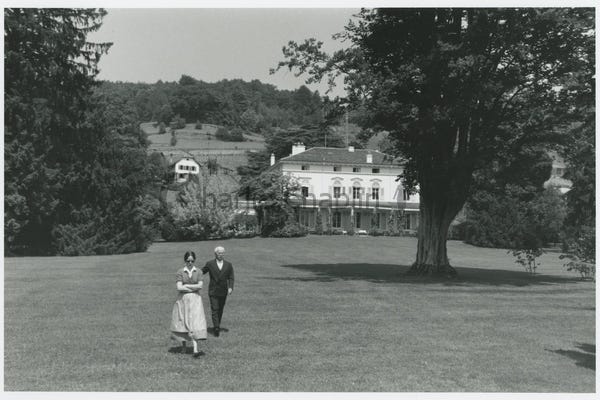
He continued to make films, specifically his film Limelight, which was heavily autobiographical. Still, Chaplain knew the political atmosphere in the United States was beginning to be toxic. So he arranged for the world premiere to be held in London. The day after he & his family left aboard the RMS Queen Elizabeth, the ship received a cablegram letting him know his re-entry visa had been revoked. Chaplain took that opportunity to cut ties with the United States, & move to Switzerland, where he continued to make films.
Throughout his life, Chaplin displayed his vast versatility, in acting, writing, music and sports. He was the author of at least four books, “My Trip Abroad”, “A Comedian Sees the World”, “My Autobiography”, “My Life in Pictures” as well as all of his scripts. An accomplished musician, though self-taught, he played a variety of instruments with equal skill and facility (playing violin and cello left-handed).
He was also a composer, having written and published many songs, among them: “Sing a Song”; “With You Dear in Bombay”; and “There’s Always One You Can’t Forget”, “Smile”, “Eternally”, “You are My Song”, as well as the soundtracks for all his films. Charles Chaplin was one of the rare comedians who not only financed and produced all his films (with the exception of “A Countess from Hong Kong”), but was the author, actor, director, and soundtrack composer of them as well.

Charles Chaplain died on Christmas Day 1977, survived by eight children from his last marriage with Oona O’Neill, one son from his short marriage to Lita Grey, and seemingly countless works of great art, humor, and empathy.
With all that in mind, we salute the great Charlie Chaplain with today’s Drink Of The Day, a Charlie Chaplin Cocktail.
Ingredients
Here’s what you’re going to need for this drink:
