
Today’s DOTD - Drink Of The Day - is a Stout Fellow cocktail inspired by the birthday of Sir Alec Guinness, on this date, April 2, 1914.
A consummate chameleon, and a stout - meaning strong - actor in almost any role, Alec Guinness is considered one of Britain’s greatest actors ever. In a long career on stage & screen, Alec Guinness successfully portrayed a broad array of characters, from a timid but larcenous bank clerk, to a brashly eccentric artist, to a tortured Cardinal, the villainous Fagin, a fiery Scottish braggart, a sad-eyed Arab prince of great cunning, and even one of the galaxy’s greatest Jedi Knights, among a host of roles.
In comedy, Guinness became most famous for his many parts as a younger man in British comedy films, including The Ladykillers, The Man In The White Suit, Kind Hearts And Coronets, and The Lavender Hill Mob.
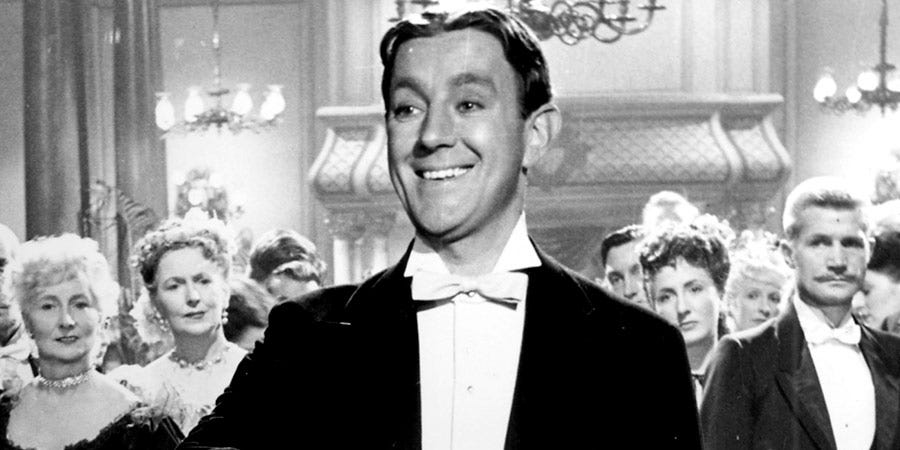
According to noted film critic Harlan Kennedy, “Almost alone among film actors, Guinness can assume the paraphernalia of makeup and funny voices and eccentric walks without losing a molecule of credibility. He never allows the weight of disguise to panic him into a matching hyperbole of voice and gesture.” Guinness once admitted: “I try to get inside a character and project him - one of my own private rules of thumb is that I have not got a character unless I have mastered exactly how he walks... It’s not sufficient to concentrate on his looks. You have got to know his mind - to find out what he thinks, how he feels, his background, his mannerisms.”
Born into poverty in London on April 2, 1914, Guinness didn’t know the legal name on his birth certificate was Guinness until he was 14. Until that time he had used his stepfather’s surname, Stiven, and didn’t even know his father existed. Guinness never met his biological father, though his bio dad provided his son’s private school funds, but refused to pay for his university education.
It was while working as an advertising copywriter in his early 20s that Guinness began going to the theatre, spending his pound-a-week salary on tickets, and beginning to study acting. Guinness owed his real start in the professional acting world to another great British actor, John Gielgud, who recommended him as a student to actress-teacher Martita Hunt (with whom Guinness would later co-star in Great Expectations). Hunt, after several lessons, gave Guinness back his money, saying ‘‘I’m afraid you’re wasting your time. You’ll never be an actor.’’ Luckily, Guinness persevered, winning a two-year scholarship to the Fay Compton Studio of Dramatic Art, where he was awarded (by Gielgud) the school’s annual prize at graduation. Later, Gielgud offered him the part of Osric in his production of Hamlet. It was the turning point in Guinness’s career. He worked for Gielgud and at the Old Vic Theatre where he was known most famously for his strong portrayal of modern-day Hamlet. His acting career kept growing - until the outbreak of World War II, .
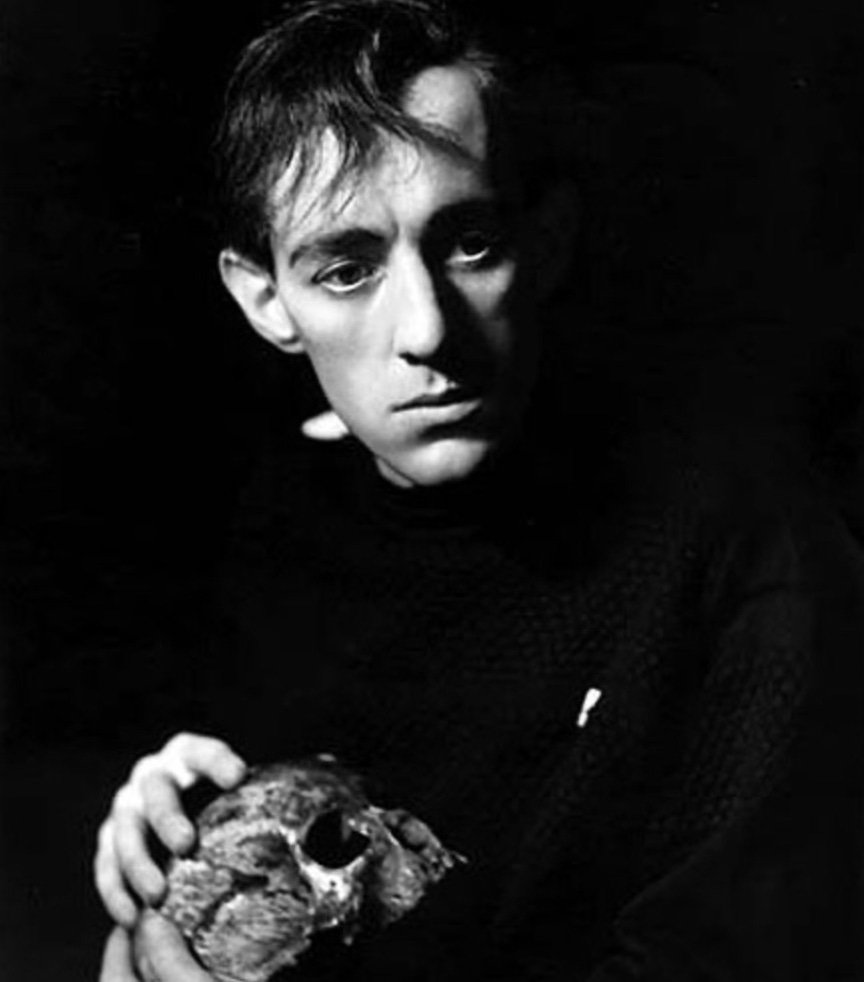
Eager to serve in the Second World War, Guinness was not immediately sent to the front. On the recommendation of another famous actor, Dennis Price, Guinness had applied to join an anti-aircraft battery at Sevenoaks, only to discover that the sergeants there were more devoted to knitting than to combat. Guinness beat a rapid retreat from that assignment, and the next year joined the UK Royal Navy as an ordinary seaman. After a spell as first lieutenant of Tank Landing Craft TLC 24 on Loch Fyne, he was sent to the United States, on board the Queen Mary, to take command of an LCI(L) - Landing Craft Infantry (Large).
Landing in New York, in December 1942, Guinness was granted leave so that he could act on Broadway in the role of Flight Lieutenant Graham in Terence Rattigan’s play Flare Path. As he noted in interviews later in life, the role of naval officer was one of the hardest he ever tackled, harder than actually being a naval officer.
After the show closed, Guinness returned to his naval service, taking his LCI(L) somewhat circuitously across the Atlantic, and in July 1943, Guinness landed his troops in Sicily. On New Year’s Day 1944, Guinness was caught in a hurricane in the Adriatic, and after a hair-raising night he finally succeeded in entering the Italian port of Termoli, only for his craft to crash on the rocks inside the harbor.
Later, in command of another LCI(L), Guinness ferried supplies to the Yugoslav partisans, and took back their wounded to Italy. “The war,” he considered, “was the greatest blessing for me. I could so easily have been stuck in West End juveniles and with people getting bored of me. I’d started to lead a rather frivolous life, and my circle of friends had become increasingly theatrical.”
Guinness’s film career began after he returned from the war, when he played Herbert Pocket in David Lean’s Great Expectations (1946), a a role he’d already played in the stage version of the Dickens novel. It was in Lean’s Oliver Twist (1948) that he had his first memorable onscreen role as Fagin, although his portrayal - complete with stereotypically Semitic gestures and heavy makeup - aroused charges of anti-Semitism in the United States that delayed the film’s stateside release for three years.
It was his fourth film, Kind Hearts and Coronets, that made him a movie star. Beginning a long association with Ealing Studios, he appeared as eight characters, ranging from a doddering parson to a militant suffragette, whom the ninth in line to a duchy (Dennis Price) has to prune from the family tree. He would subsequently be associated with a number of the classic Ealing comedies, including The Lavender Hill Mob (1951), The Man in the White Suit (1951), and The Ladykillers (1955). In The Lavender Hill Mob (1951) Guinness appeared as a myopic and underpaid bank clerk who plots the perfect robbery. The Man in the White Suit (1951) followed, a comedy about a scientist who, to the consternation of management and the unions, invents a fabric that never gets dirty and never wears out. The Ladykillers (1955) was the last great Ealing Comedy; Guinness played Professor Marcus, the mock sinister leader of a peculiarly inept gang of burglars.
Two other Ealing comedies, A Run For Your Money (1949) and Barnacle Bill (1957) achieved less fame. But Guinness also made excellent films beyond Ealing in this period, notably The Card (1952), after Arnold Bennett’s novel, in which he played ‘Denry’ Machin, the sharp-witted solicitor’s clerk who makes good through charm and unscrupulousness. His performance in G.K. Chesterton’s Father Brown (1954) was not only excellent in itself; it provided a nudge on the road to his personal conversion to Roman Catholicism.
The film was shot in Burgundy. Walking back in the dark, still in a cassock, to the station hotel of a village near Macon after a drink in the local bar with Peter Finch, his hand was seized by a small boy, a complete stranger, who called him “Mon pére” and trotted along beside him chatting in French. Despite his phony credentials as a cleric, Guinness felt strongly that the reality of this trust was important. When his 11-year-old son Matthew was temporarily crippled from the waist down with polio, Guinness had taken to dropping in on church and praying. Shortly after Father Brown, he joined the church of Rome.
His reputation as a serious actor came with The Prisoner (1955), a harrowing drama in which he played a persecuted cardinal behind the iron curtain. He considered his performance as the tortured and brainwashed Cardinal, a part he had previously played on stage, “the nearest I have come to showing my real self on cinema.”
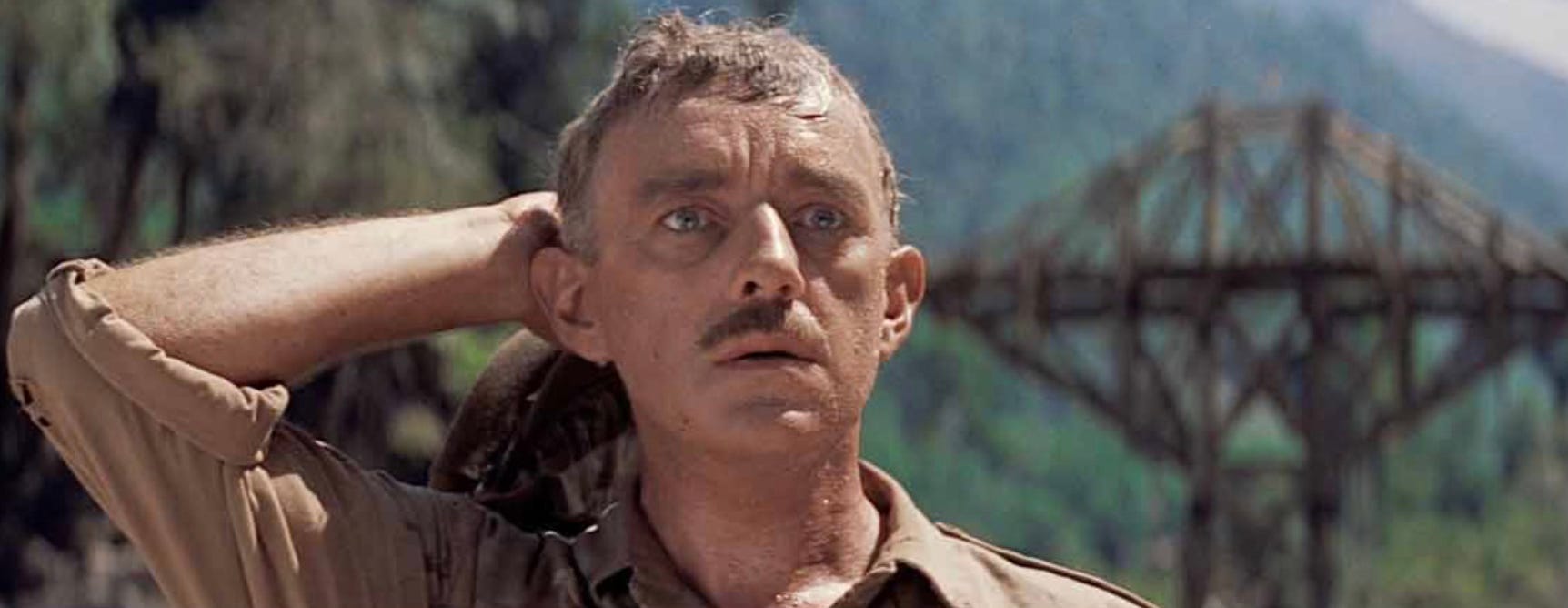
His greatest film role was probably Colonel Nicholson in David Lean’s Bridge on the River Kwai (1957), where his quintessentially English stiff upper lip and obsessive unreasonableness under, eventually, dreadful Japanese maltreatment won him an Oscar and numerous other prizes. Ironically, Guinness turned down the role twice before being persuaded to take it by producer Sam Spiegel; his performance remained one of the most acclaimed of his career.
Further award-winning work included Gully Jimson, the dirty, dishonest and abysmally impoverished artist in The Horse’s Mouth (1958), with his own screenplay based on Joyce Carey’s novel. His next great role was in Tunes of Glory (1960), Guinness’s favorite among his films. Eschewing the more familiar role of a rigid martinet outsider (effectively portrayed by John Mills), he opted for the role of Jock Sinclair, a vain, blustering, dense, red-haired, hard-drinking but somehow touchingly vulnerable commander of a Scottish regiment whose outrageously clannish behavior brings about Mills’s suicide and his own character’s ultimate downfall.
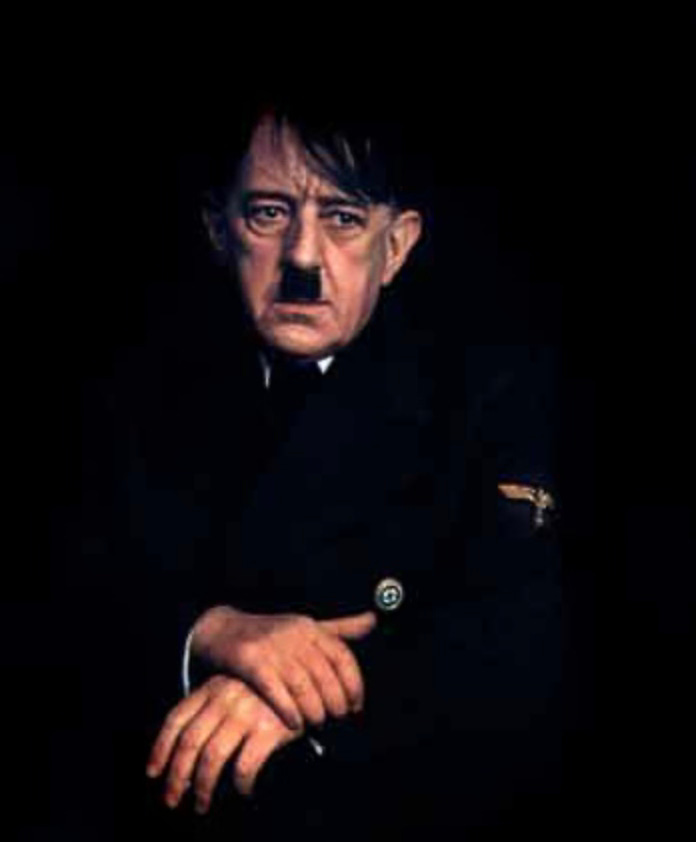
His next leading role was the first one for which Guinness received unfavorable reviews. As the widowed Japanese diplomat Koichi Asano in A Majority of One (1960), his only possible consolation was that Rosalind Russell, as the Yiddish widow Erma Jacoby, was as badly miscast as he was. In the years that followed, Guinness played a number of supporting roles, the most significant of which was the urbane Prince Feisal in Lawrence of Arabia (1962). Guinness did not find another film part worthy of his talents until 1970, when he appeared as Charles I in Cromwell. With a light Scots accent and a slight stutter he conveyed the nobility as well as the weakness and stubbornness of the king. Then, in Hitler: the Last Ten Days (1973) Guinness - having discovered through his usual assiduous research that Hitler was a boring man - succeeded brilliantly in bringing this accurate interpretation to the screen.
Although Guinness continued to work at a fairly prolific pace throughout the 1960s and 1970s, his popularity was on the wane until director George Lucas practically begged him to appear as Obi Wan Kenobi in Star Wars (1977). The role earned the actor his third Academy Award nomination (his second came courtesy of his screenplay for Ronald Neame’s 1958 satire The Horse’s Mouth) and introduced him to a new generation of fans. Guinness reprised the role for The Empire Strikes Back (1980) and Return of the Jedi (1983); although the role Obi Wan was perhaps the most famous of his career and earned him millions, having been employed on a royalty of 2.5 percent, he reportedly hated the character and encouraged Lucas to kill him off in the trilogy’s first episode so as to limit his involvement in the subsequent films.

Guinness’s performance as the Brahmin Professor Godbole in David Lean’s version A Passage to India (1984) was the only occasion on which he received almost universally bad notices. He had been at odds with director David Lean on the set, and suffered from much of his part being left on the cutting room floor.
Guinness has also turned in some outstanding performances on television—most notably in Tinker, Tailor, Soldier, Spy and Smiley’s People, based on the espionage novels of John Le Carré; Little Lord Fauntleroy; and Monsignor Quixote, from the novel by Graham Greene. He also had a small role in Kafka, released in 1991. In 1988, Guinness returned to the big screen, and to Dickens country, earning his fourth Oscar nomination - for his work in a six-hour adaptation of Dickens’ Little Dorrit. In addition to acting, Guinness focused his attention on writing. In 1985 Guinness published Blessings in Disguise, a delicate, charming, and literate example of modern theatrical memoirs. Two volumes of diaries followed, My Name Escapes Me (1996) and A Positively Final Appearance (1999).
One of Guinness’s last screen performances was in the television film A Foreign Field (1993), in which he played an ex-soldier returning to France 50 years after his wounds had reduced him to a state of childish oblivion. It was almost as though, at the end of his career, he sought the most testing possible challenge of his technique before the cameras; if so, he vindicated himself with consummate art.
Guinness was a charming, fascinating and elusive companion. He did not enjoy playing the star, though he liked the respect he got when visiting famous restaurants. He liked good food and drink. His favorite London hotel for years was the Connaught, with its superb cuisine. He lived modestly, outside Petersfield, England, from the mid-1950s on, with a large garden that that he tended with his wife Merula. He had a small circle of friends, many outside the theatre. For years he and Merula were close to Rachel Kempson and Michael Redgrave.

In 1955, Guinness’ contributions to the arts were recognized by Queen Elizabeth, who dubbed him Commander of the British Empire and in 1959, he was knighted. He died on August 5, 2000, at the age of 86, from liver cancer, leaving behind his wife Merula to whom he was married 62 years, a son, Matthew, and one of the acting world’s most distinguished legacies.
Ingredients
Here’s what you’re going to need for this drink:
