
DOTD For Thursday, February 26, 2026
Today's Drink'll Hit Ya - Pow! Right In The Kisser
Today’s DOTD - Drink Of The Day - is a Honeymoon Cocktail inspired by the birthday of legendary actor Jackie Gleason. He was born on February 26, 1916.
Christened “The Great One” by Orson Welles, after a long and liquid night on the town, Jackie Gleason embraced all that the title implied.
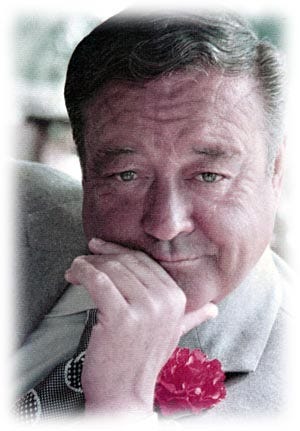
From his penchant for fine food, generously poured scotch, and beautiful women; to his ability to dominate a room, stage, or the screen; from his taste for custom-made suits, monogrammed shirts, and the ubiquitous red carnation, to his appetite for the biggest, the best, and just a dollar more than the other guy made - it all became a part of the Gleason legend which began on Brooklyn’s Herkimer Street in 1916.
Born Herbert Walton Gleason, Jr. and baptized John Herbert Gleason, his mother, Mae, called him Jackie. There’s not much known about his early family life, though his older brother Clement, always frail and sickly, died from complications of meningitis at age 14 in 1919, when Jackie was only three. A few years later, his father Herb, a somewhat quiet insurance adjuster, burned all the family photos that he appeared in, and the following day, took his hat, coat, and paycheck and walked out the door – in mid-December, just before Christmas, never to return. Once it became evident that Jackie’s father was not coming back, Jackie’s mother went to work as a subway attendant, and raised her son alone as a working mother.
Although Mae was determined that young Jackie live the Catholic faith and receive the sacraments, she could do little to encourage his academic life.
After his father abandoned the family, young Jackie began hanging around with a local gang, cutting from school, & hustling pool. When he did show up to one of the two different high schools he eventually went to, he got involved in the theatre department. Gleason became thoroughly interested in performing after being part of a class play, and after that, he saw little need to stay in school. Gleason quit high school before graduating and got a job that paid $4 per night (equivalent to $99 a night in 2025) as master of ceremonies at a theater. When asked by a journalist in the 1970s why he loved acting so much, he reportedly replied, that every time he performed, “a great feeling of friendship came from the audience,” something that he couldn’t get anywhere else.
The young Mr. Gleason quickly began appearing at service and fraternal organizations, becoming a master of ceremonies, a stand-up comedian, and monologist. Other non-acting jobs he held at that time included pool hall worker, stunt driver, and carnival barker.
Jackie Gleason was 19 when his mother died in 1935 from complications of sepsis. He had nowhere to go and only 36 cents to his name. The family of his first girlfriend, Julie Dennehy, offered to take him in. Gleason, however, was headstrong and insisted that he was moving into the heart of the city. Like many young performers, he began rooming in the city with a couple of his friends, until one of them told him about a week-long gig in Reading, Pennsylvania that would pay $19 a week — equivalent to $440 in 2025 dollars. The booking agent for the gig advanced his bus fare for the trip against his salary, and granted Gleason his first job as a professional comedian, a surprisingly steady job during the Great Depression of the 1930s.
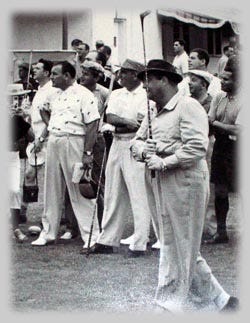
In 1934, during the Great Depression, when unemployment wavered between 21% and 23%, Jackie Gleason always had steady work. Not lucrative, but steady. His resume listed The Majestic, The Central, The Folly, and The Halsey Theatres in Brooklyn, while he played Club Miami and the famous Empire Burlesque in Newark. He often worked two or three theatres at a time, skipping from Brooklyn to Jersey and back again in a single night.
Because he was a quick study, he also became house comic at The Empire club, a promotion which terrified him at first. On Sunday morning, he’d receive a script and then perform that same Sunday night. He quickly learned from the circuit pros that there were no scripts set in stone, no time for rehearsals, and that “if you wanna make it kid, you have to make it your own.”
Gleason worked his way up to larger clubs in Manhattan, first Leon and Eddie's, and then Jack White's madcap Club 18, where insulting the patrons was the order of the day. Gleason once greeted famous ice skater Sonja Henie by handing her an ice cube, then staring at her saying, "Okay, now do something." Gleason could also be a bit more charming than that, like when he met dancer Genevieve Halford in late 1935, when they were both working in vaudeville. After a whirlwind romance and an ultimatum from Halford, they were married on September 20, 1936.
By now Jackie was receiving positive press and began working clubs in Manhattan which landed him a role in Along Fifth Avenue. The show opened on Broadway to fair reviews. Each night after the final curtain, JAckie headed back to the clubs, where he worked The Torch, Leon and Eddies, or Club 18 on 52nd street, where all the action was. “I’d be lost if I didn’t work on the floor until two or three in the morning,” he once said. Pioneering studio mogul Jack Warner had seen him at several of these spots in and around New York, and Warner finally offered Gleason a contract he couldn’t refuse.
By 1941, Jackie had two daughters, Geraldine and Linda, who were living with his wife on Long Island, while he lived alone in Hollywood. By day he sat around the set at Warner Brothers, and ultimately made eight fairly forgettable films. By night, he played supper clubs around Southern California, much like he’d done back in New York. He traveled back to Broadway where his reviews were brilliant for Follow The Girls, and legendary nightclub owner Billy Rose hired Gleason for his glitzy, star-studded night club, The Diamond Horseshoe. He reconciled with, and then separated again from Genevieve, meanwhile playing clubs from New York to L.A. He was a popular comedian and minor actor at this point, but by no means was he a household name.
Then, his breakout opportunity came in 1949, when after working nightclubs and earning the attention of New York City’s inner circle, he landed work with the fledgling DuMont Television Network. His first role with DuMont was the role of blunt but softhearted aircraft worker Chester A. Riley for the first television version of the radio comedy The Life of Riley. Despite positive reviews, the show was canceled after one year, in part to DuMont’s substantial disadvantages. However, Dumont had a variety show called Cavalcade of Stars that needed a host, and Gleason was recommended as one of several rotating hosts for the job. Soon, he became permanent host, where he developed the stable of sketch characters he would refine over the next decade.
Two years later, still in command on Dumont, CBS wooed him away, inviting Gleason’s characters Ralph Kramden, Joe the Bartender, Reggie Van Gleason III, and The Poor Soul to take up residence on their network.
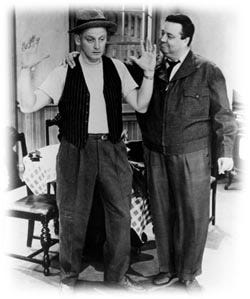
Gleason signed with CBS on November 23, 1951 and The Jackie Gleason Show began. The variety show, which commanded more than 160 team members as production staff, included actors, dancers, musicians, choreographer June Taylor, a large technical crew, wardrobe, and make-up. The show was broadcast live for the first time on September 20, 1952. Gleason’s show had splashy dance numbers, inspired by Busby Berkeley’s screen dance routines and featured the precision-choreographed June Taylor Dancers. Following the dance performance, he would do an opening monologue, and later in the program, sketches that included his growing stable of characters. The ratings soon soared, and the program became the country’s second-highest-rated television show. Jackie quickly became known as “Mr. Saturday Night.”
By 1955, Gleason’s show’s format had changed to accommodate the wild popularity of The Honeymooners sketches. The idea was to split Gleason’s time slot into two half hour shows: The Honeymooners, and Stage Show, a music and variety combination show hosted by the Dorsey Brothers. Both shows were owned by Gleason. The 1955-56 episodes of The Honeymooners became known as the “original thirty-nine.”
Ot was at this point Jackie Gleason’s career really took off.
During the 50’s and 60’s, Gleason also recorded 43 albums of mood music, wrote the theme songs for his show (“Melancholy Serenade”) and The Honeymooners (“You’re My Greatest Love”), built a round house in Peekskill, New York, starred in nine films, garnered an “Oscar” nomination for The Hustler, won a “Tony” for his Broadway performance as Uncle Sid in Take Me Along, hosted or performed in 30 television specials, and moved his new television show (American Scene Magazine) and its entire entourage via train to Miami, Florida. In 1969, he and Genevieve divorced.
In the next decade and a half, Gleason married (1970) and divorced (1974) Beverly McKittrick, and then married (1975) June Taylor’s sister, Marilyn Taylor, with whom he had an affair during his first marriage in 1954. Gleason starred in eight films including Smokey and the Bandit I, II, and III, The Toy, and his last film, opposite Tom Hanks, the Garry Marshall-directed Nothing in Common, a critical and financial success.
In addition, Gleason hosted or guest-starred in 17 television specials, created the annual Inverrary Golf Classic, filmed five Honeymooners specials, and released The Lost Honeymooners for syndication, (which includes all episodes other than those filmed during the 1955-56 season). In 1978 he underwent quadruple coronary bypass surgery.
In 1986, Jackie was diagnosed with diabetes and phlebitis, but he knew his medical condition was more serious. “I won’t be around much longer,” he told his daughter at dinner one evening after a day of filming Nothing In Common.
On June 24, 1987 Jackie passed away from colon cancer which had metastasized to his liver at his home in Inverrary, Florida. His Memorial Mass was celebrated by the auxiliary Bishop of Miami, His Excellency Bishop Norbert Dorsey who said about Jackie, “Throughout his professional life (Jackie) kept the heart of a child, a whimsicalness that cheered up a sad and tired world.”
Gleason is buried at Our Lady of Mercy Catholic Cemetery in Miami, in a lavish above-ground mausoleum that suits “The Great One.” Etched into the marble stairway leading to his sarcophagus reads the inscription of one of his most famous lines, “And Away We Go.”
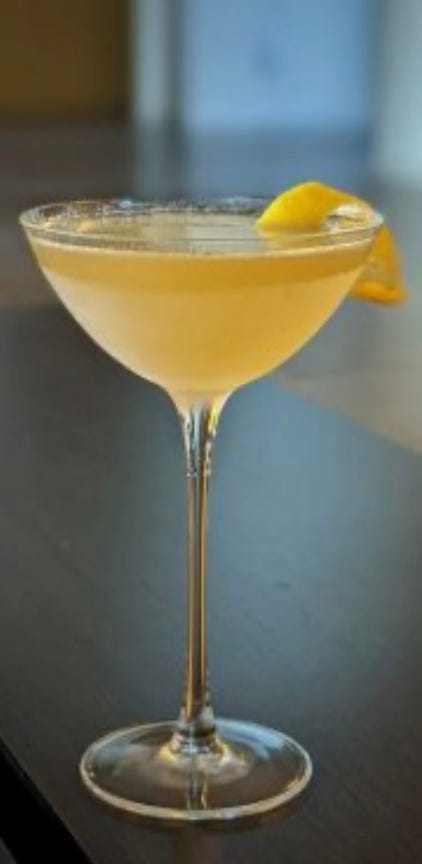
As a salute to this prolific actor, singer, producer, and entertainer, we give you today’s Drink Of The Day, a Honeymoon Cocktail. To the moon! (Or, y’know, to the recipe.)
Ingredients
Here’s what you’re going to need for this drink:
