
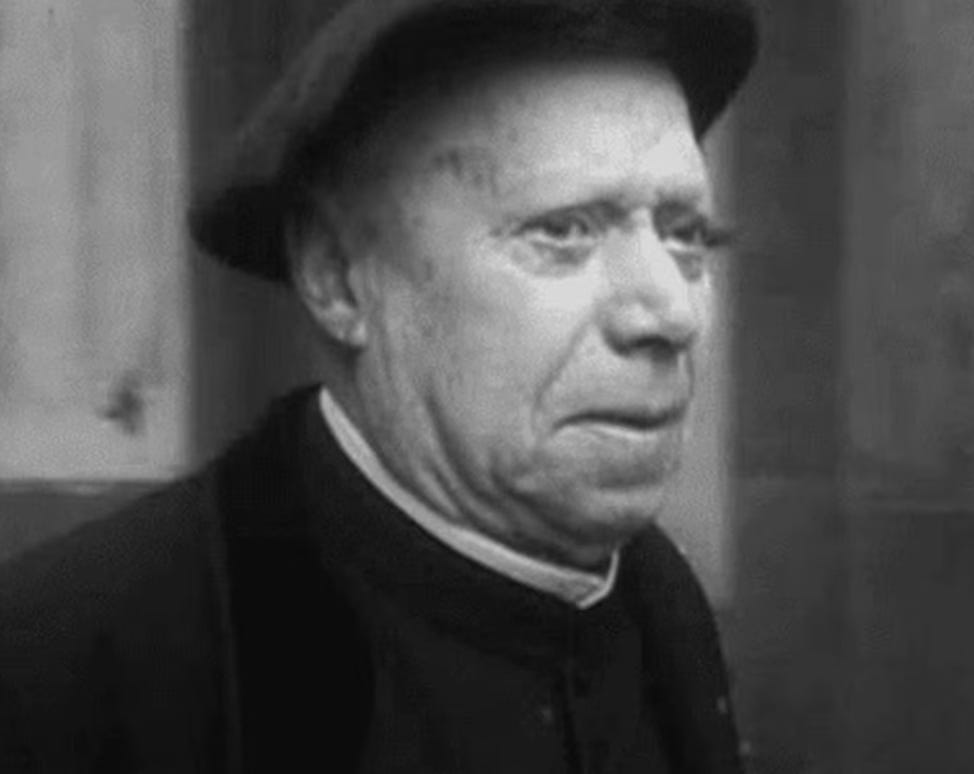
Today’s DOTD - Drink Of The Day - is a Kir Royale inspired by French Catholic priest, World War II antifascist resistance hero, and French politician, Felix Kir, best known for helping to free more than 5,000 prisoners of war .
Born on January 22, 876, Felix Kir entered the seminary in his teens and was ordained as a Catholic priest in 1901. He was then posted to the commune of Auxonne, near his hometown in Dijon, France. When the first World War broke out, he was one of an estimated 25,000 priests and seminarians who were conscripted into the French army. He was reportedly very popular with his comrades in arms, who liked his positive attitude. After the war, he returned to his presbytery in the town of Bèze with a Croix de Guerre medal.
His bishop promoted him and Kir took an increasing interest in politics. He started to write in a Catholic newspaper, with agriculture being one of his favorite topics. In the 1936 general election, he wanted to throw his hat in the ring, but his bishop was not in favor of that action, so Kir declined to run.
In June 1940, when the mayor of Dijon fled ahead of the approaching Nazi German army, Kir stood in to reassure the local population. Together with several others, he was temporarily appointed to head up the municipal council. He helped a large number of prisoners of war escape rather than fall into the hands of the Germans. For this, he was later tried and sentenced to death, twice, by two different German military courts.
Luck was on Kir’s side, however, and he was released after a subsequent inquiry. He worked closely with communist members of the Resistance and was arrested again in October 1943. This time, he was charged with helping people flee to England. He somehow managed to get off this charge, but his patriotic allegiance to France made him a thorn in the side of the occupying force.
In January 1944, two masked men from a pro-Vichy militia forced their way into his house in the centre of Dijon. They opened fire and he was wounded in both the arm and leg. One bullet hit his wallet, probably saving his life. He recuperated in a secret location outside the city, avoiding detection by the Gestapo.
On the morning of September 11th, 1944, Kir returned triumphant to Dijon just as French tanks were arriving to liberate the city.
Elected by a large majority as mayor of Dijon in April 1945, his simple manifesto promised to “feed, clothe, house” the residents of his town. He was re-elected as mayor in many subsequent elections. At the age of 70, Kir also ran for and won national office as a member of the French National Assembly. He ended up representing both his howntown and the wine region of Côte-d'Or, in Burgundy, for 22 years, continuing in both positions until his death in April 1968.
In his role as mayor, Kir looked outside of France to make connections. During his time in office, Dijon was paired with many cities, including Dallas, Texas in the United States, and Volgograd (which was called Leningrad at the time) in the Soviet Union. The Catholic Church was no friend to the USSR, so when the Soviet premier, Nikita Khrushchev, toured Dijon in 1960, Kir was forbidden by his religious superiors to welcome the visiting dignitary. Kir’s speech to Khrushchev was instead read out by one of his assistants, but he did have his way, and subsequently met Khrushchev in Paris and later in Moscow.
In the French parliament, Kir sat on various committees over the years, including education, youth affairs, social security, pensions, and food supplies, a key problem after the war. Kir spoke up in debates on a range of issues. For instance, he was in favor of atomic energy, European integration, and the construction of a tunnel under Mont Blanc, France. However, he thought that Algeria should remain part of France.
Kir was a colorful and popular, if at times, truculent, member of parliament. It is highly ironic that a priest who disagreed with the new French law to formally separate church and state in 1905 and even got into trouble for trying to stop state agents from making an inventory in his church, ended up sitting in the parliament and enacting laws.
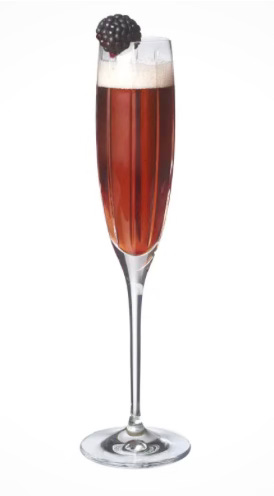
It’s also ironic that this churchman has given his name to an alcoholic cocktail, known as a Kir Royale.
When entertaining guests as mayor of Dijon, France, Kir used to serve a blanc-cassis, as it was known at the time. The drink has since been rechristened Kir in honor of this colorful personality, who did so much to popularize it.
To Felix Kir, and to all who fight fascism, we raise a glass tonight of the Drink Of The Day, a Kir Royale.
Ingredients
Here’s what you’re going to need for this drink:
