
DOTD For Thursday, June 18, 2026
This One Will Wet Your Whistle & Make You Bob Your Head
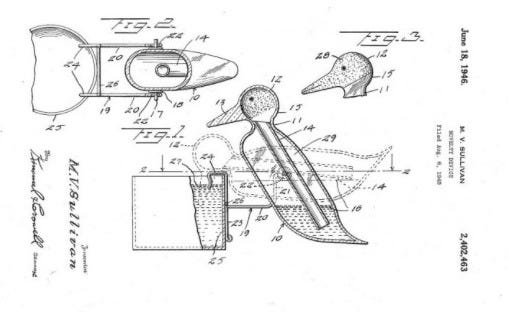
Today’s DOTD - Drink Of The Day - is a Salty Bird Cocktail inspired by the invention of the Drinking Bird novelty toy, which was first given a U.S. patent on June 18, 1946. That’s the day Miles V. Sullivan, a Ph.D. inventor-scientist who worked at Bell Labs in Murray Hill, NJ, and specialized in semiconductors - but also invented kids toys on the side - received U.S. Patent #2402463 for a “novelty device” in the form of an ever-bobbing bird that remains popular to this day.
The Brief History Of The Amazing Drinking Bird
While Miles Sullivan is credited with getting the U.S. patent that allowed this toy to become a nationwide sensation, the knowledge of thermodynamics involved in this toy go back much farther.
While humans have used heat for millennia to cook or run rudimentary steam machines, the scientific equations that govern energy, heat, and their transfer, were discovered and codified in the 1800s. By the early 1900s, a similar Chinese drinking bird toy called ‘The Insatiable Birdie’ was described in the book Physics for Entertainment by Russian science writer Yakov Perelman. In 1922, when Albert Einstein and his second wife Elsa visited Shanghai, China, they saw one of these little birdies, operating on the exact same thermodynamic principles as Sullivan’s toy, and were fascinated by it.
Thermodynamics & How The Bird Works
The drinking bird is a mesmerizing little science toy that has fascinated young and old alike for more than a century. Also known as the happy bird, the dippy bird, the happy dippy bird, and other similar variations, this toy is a perfect example of how thermodynamics - the branch of physics that studies the relationships between heat, work, temperature, and energy - actually works.
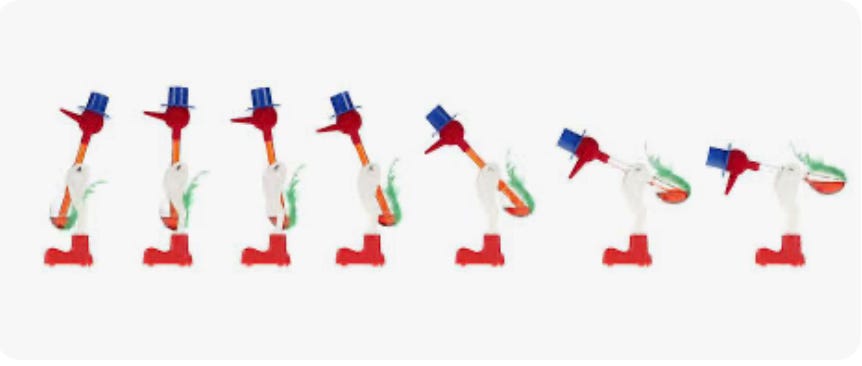
The drinking bird operates based on the principles of thermodynamics and fluid dynamics. At its core, the bird consists of two sealed glass bulbs connected by a single tube. The lower bulb is partially filled with a scientifically “volatile” liquid, usually methylene chloride, which evaporates at a relatively low temperature. When the beak of the bird is moistened, water is absorbed in the material around the head bulb. As the water evaporates, it cools, causing the temperature in the head bulb to drop. This temperature difference creates a pressure difference between the two bulbs, causing the liquid to rise up the tube. As the liquid shifts, the bird becomes top-heavy and tips over, dipping its beak into the water and restarting the cycle.
How It Works, In Detail
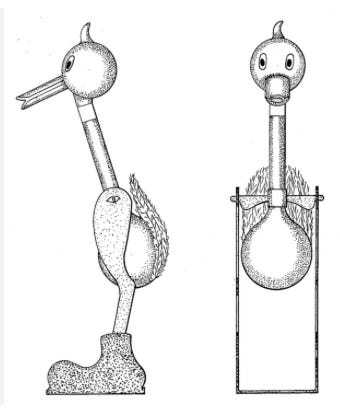
The only way any substance can pass between the two bulbs is through the narrow glass tube at its center, that connects two bulbs - one on top, and one on the bottom. The top bulb is covered with a porous felt like material that also makes up the beak. On top of the head is a plastic top hat, which is only for decoration. Taped to the bottom chamber are tail feathers, which help it to maintain balance. The whole thing is suspended from plastic legs, with a horizontal piece of metal that acts as a pivot, allowing it to bob up and down. Inside, the drinking bird is a highly volatile liquid known as methylene chloride (CH2Cl2).
Since methylene chloride is colorless, coloring must be added to enhance the visual effect. This liquid is also highly volatile, meaning it evaporates rapidly due to weak intermolecular bonds in its liquid state. Its boiling point is 39.7 °C (103.5 °F), and its vapor pressure at room temperature is 46 kilopascals (compared to only 3 kPa for water). Methylene chloride is somewhat toxic, so if a drinking bird breaks, care must be exercised in cleaning it up. Methylene chloride is commonly used as an industrial cleaner, degreaser, and paint remover. After the methylene chloride is added by the manufacturer, most of the remaining air is then vacuumed out.
Because a near vacuum now exists within the bird, the highly volatile liquid readily evaporates until the space above the liquid is saturated with vapor. At this point, a dynamic equilibrium is established within the bird between the liquid and the vapor above it. Once equilibrium is established, anytime a molecule evaporates, another molecule will condense, resulting in an overall constant amount of vapor within the bird as long as the temperature stays constant.
To activate the drinking bird, his head is dipped into a glass of water, or other evaporative liquid, and he is then set upright in such a position that when he tips his beak, he will be able to reach into the glass of water. Once the head is wet, a strange thing immediately begins to happen. Like magic, the fluid begins to rise upward into the head, until his head fills with liquid. The head then becomes top heavy as the center of gravity of the bird is raised. The bird then topples over, takes another drink. As the bird tips over, the liquid flows back to the bottom bulb, restoring the low center of gravity. The bird resumes its upright position, beginning the whole process all over again.
To understand what makes the fluid rise within the bird, think about what happens whenever your own head gets wet. As long as the relative humidity is not 100%, the water will immediately begin to evaporate. And evaporation always causes cooling, because it is an endothermic process. That’s why you sweat when you get hot; it’s not the sweating itself that cools you, but rather the evaporation of the sweat from your body. Any phase change that requires bond breaking will be endothermic, because energy is required to break bonds. This energy is drawn from the surroundings, thereby causing the temperature of the surroundings to decrease. Because water evaporates from the head of the bird, the head immediately begins to cool. This is the most crucial point in understanding how the drinking bird works.
Cooler Heads Prevail
If you could cool the head another way, the drinking bird would work just the same. When the head begins to cool, some of the vapor within the head will condense into tiny droplets of liquid. A similar process occurs at night when water vapor condenses out of the air as it cools, forming dew on the ground. Because some of the vapor condenses within the top chamber of the bird, there is now less vapor pressure in the top bulb. Less vapor means less pressure. But the vapor pressure within the bottom bulb has not changed. Because the vapor pressure in the bottom bulb is now greater than the pressure in the top bulb, the liquid is forced upward into the top chamber. (Don’t say the liquid is sucked up into the top chamber—science never sucks!) Once the bird tips over, vapor from the bottom travels to the top until the pressure in both spheres equalizes and the bird begins the process all over again.
To understand how a pressure differential causes fluid within the bird to rise, consider what happens when you use an ordinary drinking straw. When you suck fluid up into the straw, you create a region of reduced pressure within the straw. Because outside air pressure is greater, it pushes downward on the surface of the fluid, forcing it upward.
Drinking Bird Toys, In The Wild
Not only is the drinking bird educational, but it can also provide hours of entertainment. Many science museums feature displays of drinking birds. No science classroom would be complete without one. The amazing drinking bird has even appeared in a 1995 episode of The Simpsons, where Homer positions a drinking bird in front of his keyboard to help monitor the controls at the Springfield nuclear power plant. The artist Daniel Reynolds spent a small fortune and several years developing an art exhibit comprising a whole flock of giant 6½ feet tall drinking birds, each weighing 3,000 times more than an original drinking bird. They had to be made with a special vacuum attachment in order to work properly.
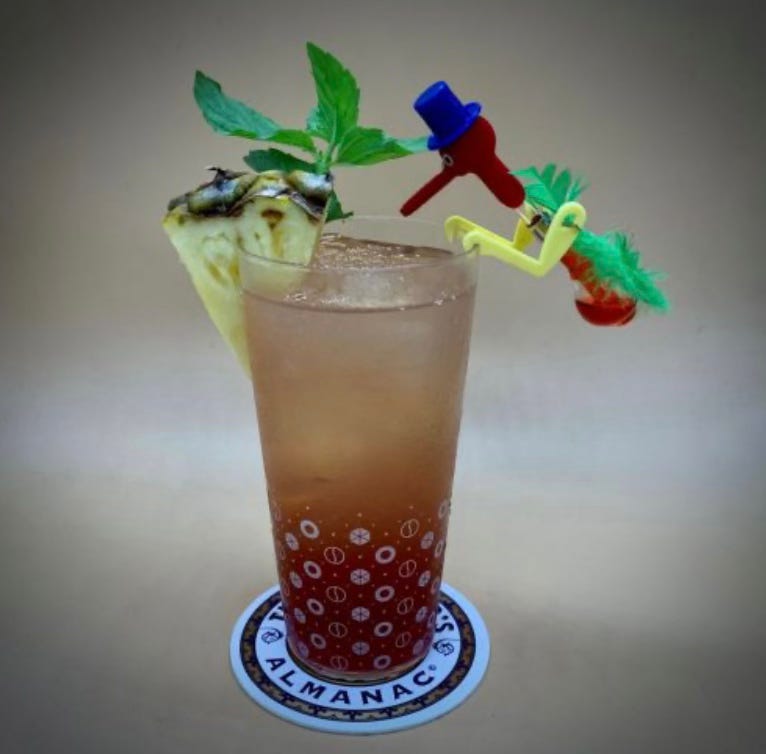
There are many variations on the drinking bird. They come in a variety of styles and sizes. There is even a drinking giraffe! The very popular, but falsely named “hand-boiler” is nothing more than a drinking bird that is stripped down to the bare essentials. It works either by cooling the top or warming the bottom.
The next time you need a unique gift for the person who has everything, consider a drinking bird toy. A quick search on the Internet will reveal a plethora of sellers willing to help you with your gift-giving. They especially make great gifts for science teachers!
And on that note, let’s dip out own beaks in today’s Drink Of The Day, a Salty Bird Cocktail!
Ingredients
Here’s what you’re going to need for this drink:
