
Today’s DOTD - Drink Of The Day - is a Stone Fence cocktail, a simple colonial-era drink popular in cold, pre-revolutionary Boston. The inspiration for today’s DOTD is the Boston Massacre, a horribly unjust event in U.S. history, that actually may have provided the very basis for justice, and the Sixth Amendment.
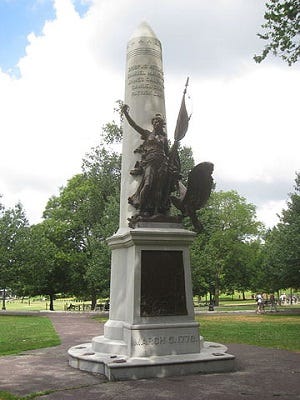
Prelude to a Massacre
At the conclusion of the Seven Years War in 1763 - a global conflict between England & France - England had accumulated a massive military bill, doubling their national debt, and needed to increase national income. The English Parliament settled on the idea of taxing their North American colonies for extra money, and justified the taxes as providing security for England. Samuel Adams, James Otis Jr., and others in the American colonies had no intention of paying even more taxes for England’s latest stupid war - and certainly not paying more in taxes without representation in Parliament. The fight over taxes and representation led to violent outbreaks in the streets between Bostonians and royal customs officials. To quell the violence, British soldiers began occupying Boston, starting in 1768.
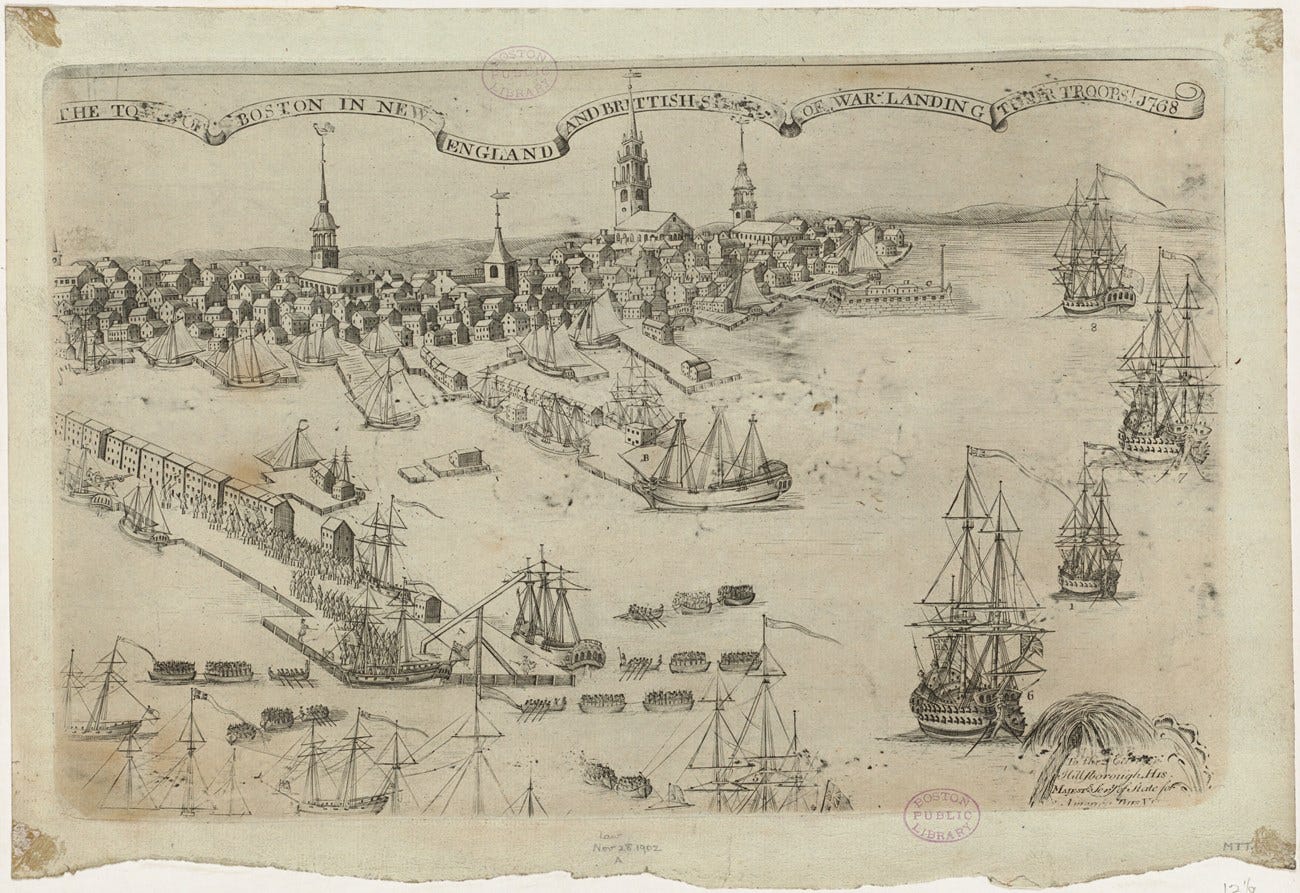
The military occupation did little to subdue the rising anger between Boston colonists and British power. Instead of controlling the population, British military presence only exacerbated the issue. An editorial, The Journal of the Times, recorded daily interactions between soldiers and colonists and painted a picture of deteriorating relationships between empire and people.
On January 24, 1769, the editors of The Times described a fight between several officers and town watchmen after the officers had “beat and wounded…very cruelly” an inhabitant of Boston. The violence extended beyond engagements between colonists and soldiers. In other instances, open conflict erupted between colonial supporters (who became Patriots) and British supporters (Loyalists).
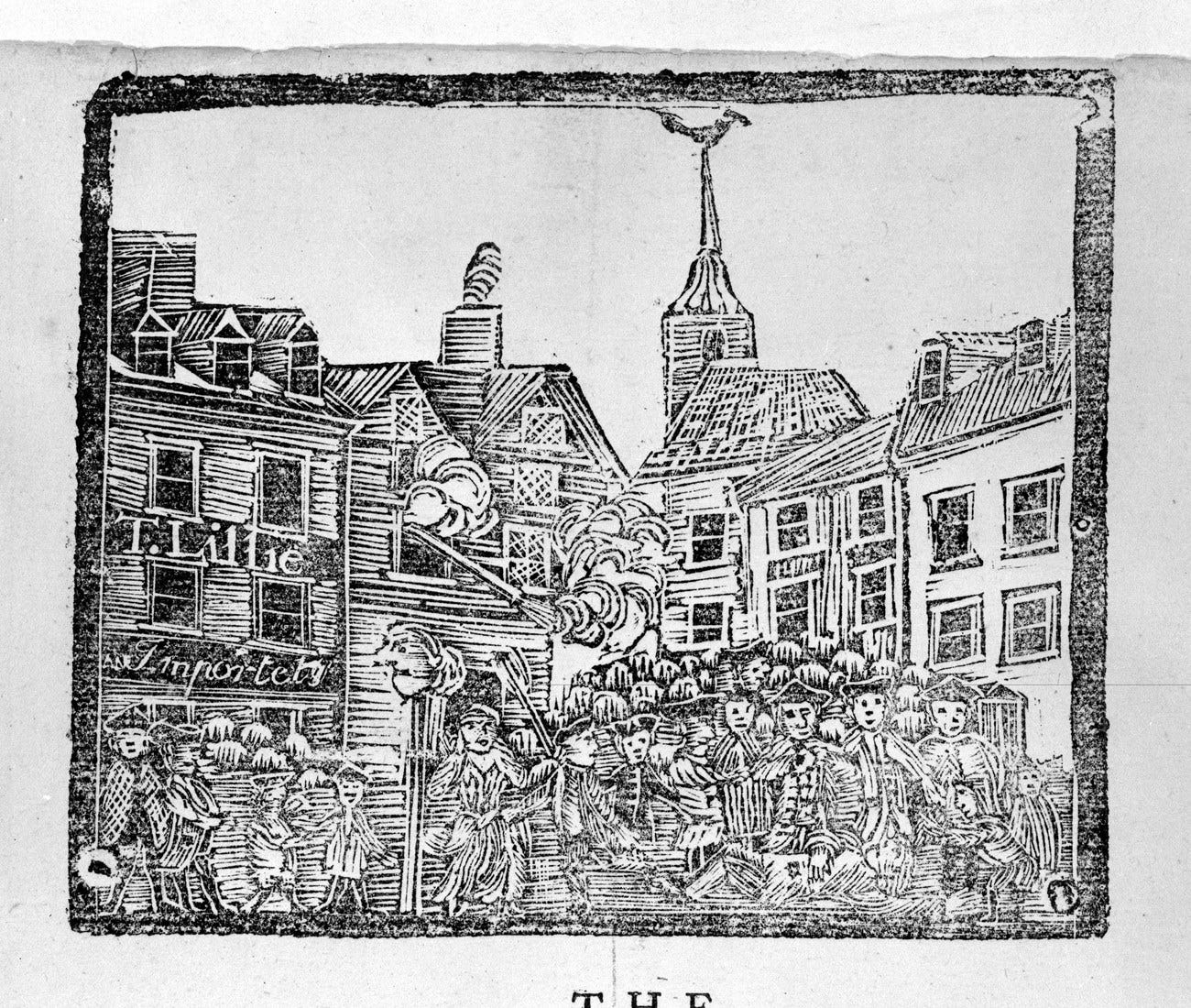
The most notable episode of this conflict cropped up over non-importation – the belief that the colonies could affect English policy by reducing goods purchased from England. Boston merchants and consumers who did not adhere to non-importation became political targets and risked open hostilities against themselves and their property. In February 1770, a group of young boys attacked the shop of Theophilus Lillie. Ebenezer Richardson, a patron of Lillie’s shop, attempted to clear the street but only provoked the crowd more. As Richardson retreated home, the group called Richardson an “Informer” and berated him with verbal assaults. At Richardson’s home the crowd grew. Richardson attempted to disperse the crowd by threatening to fire upon them with his rifle. The crowd did not retreat, and Richardson fired birdshot into the crowd, hitting Samuel Gore and Christopher Seider. Seider, an eleven-year-old boy, died from his wounds.
March 5, 1770
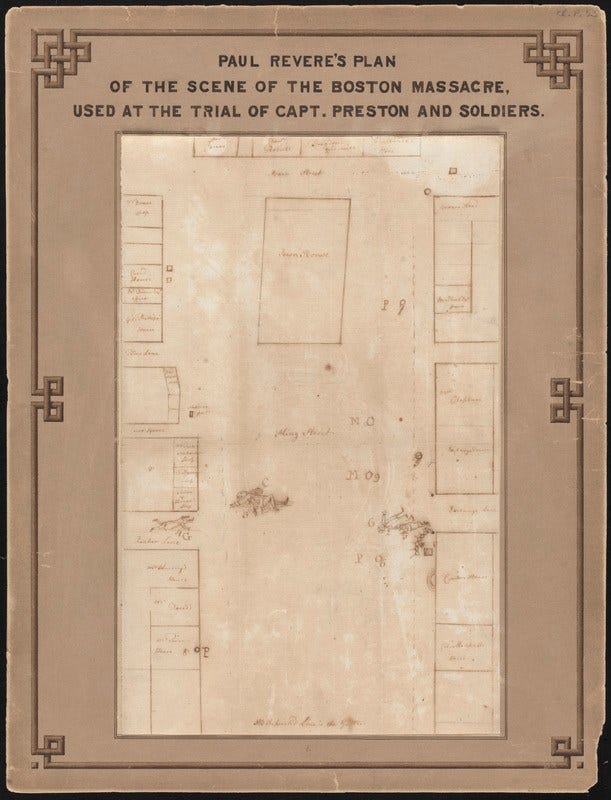
Tempers cooled, temporarily, following Seider’s death, and life in Boston continued. The evening of March 5, 1770, began normal enough. It was a cold frigid night. A light snow covered the streets and walkways. Many residents escaped the cold indoors and British soldiers took to their barracks. Private Hugh White, scheduled for sentry duty, took his position outside the Custom House on King Street just beyond the Town House.
The quiet of the night soon turned as colonists, almost as if signaled, took to the streets looking to agitate British soldiers into some sort of irreversible action. In multiple places throughout Boston, groups of colonists came into conflict with British soldiers – near the Liberty Tree, down Boylston’s Alley, near Murray’s Barracks, and at Dock Square – but the greatest conflict occurred on King Street.
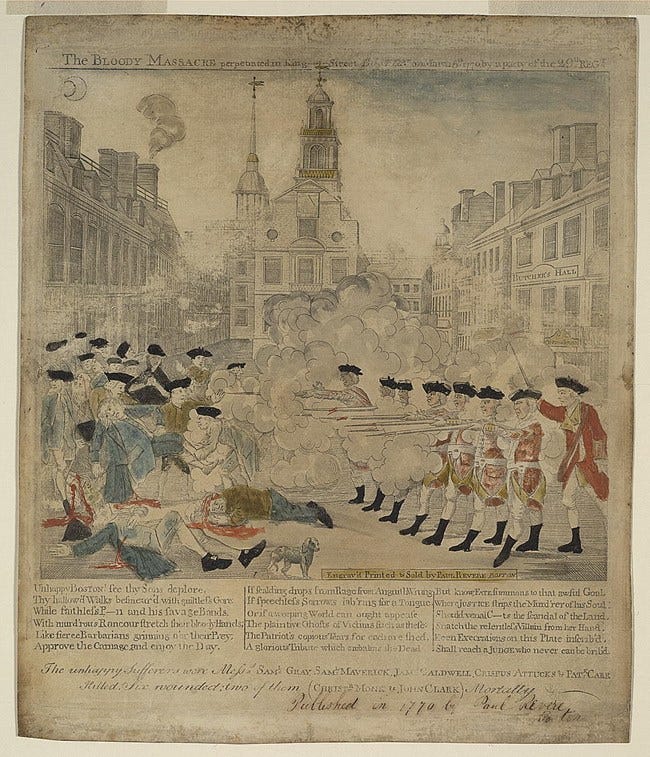
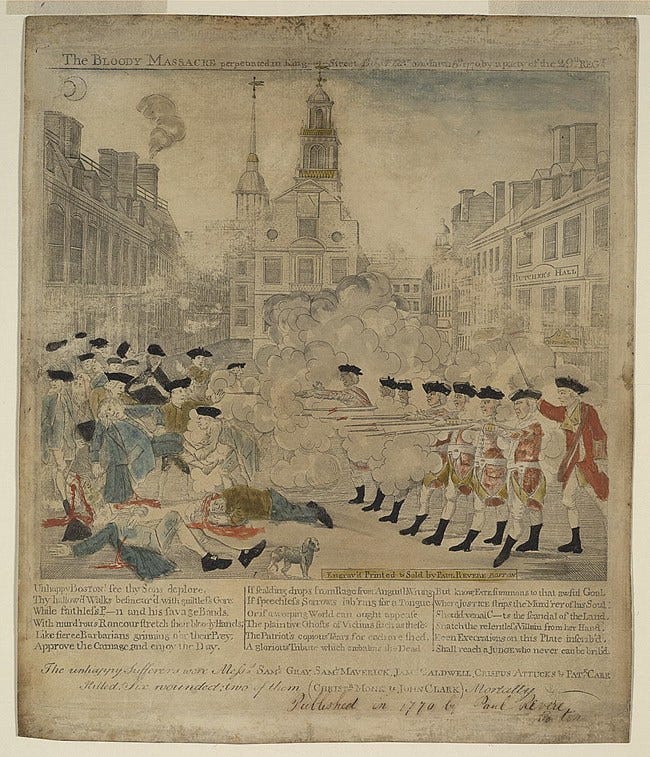
Colonists surrounded Private White, hurling insults and objects at the sentry who called out for reinforcements. Hearing this plea, Captain Thomas Preston led a small cadre of soldiers to rescue Private White. By this time, a large number of colonists had encircled the soldiers and they could not leave their place outside the Custom House. Insults and objects continually fell upon the soldiers until one shot rang out in the night. An eerie silence followed.
The silence was broken by a volley of gunfire from the British Regulars tearing into the colonists. Panic ensued and the people fled. The soldiers – Hugh Montgomery, James Hartigan, William McCauley, Hugh White, William Wemms, Jon Carroll, Matthew Kilroy, William Warren, and Captain Preston – remained rooted and gazed upon this massacre. After a few cautious moments, Preston marched the eight soldiers back to the Main Guard. They took up position outside the State House and were again surrounded by Bostonians who returned and demanded action against Preston and the soldiers. Governor Thomas Hutchinson soon adhered to their demands and ordered Preston and the soldiers arrested.
The Immediate Aftermath
With British soldiers in jail, the Boston Massacre created a new struggle. Over the next nine months, Boston colonists and British soldiers argued over March 5. They debated the events of the night and its larger significance to not only shape eighteenth-century public perception, but define the Boston Massacre for future generations.
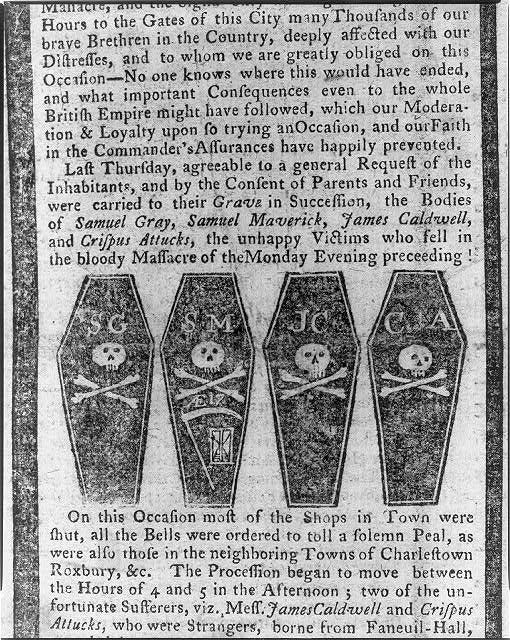
The battle for public perception began on March 8. Samuel Adams, a member of the Sons of Liberty, led a funeral procession for the victims of the Boston Massacre. Witnesses suggest 10,000 people (approximately 67% of Boston’s population) attended the funeral of Samuel Gray, Samuel Maverick, James Caldwell, and Crispus Attucks, the first four victims of the massacre. In this political move, Adams consciously guided the procession through Boston using pageantry to vilify British oppression – festering since the early 1760s – and promote colonial unity over British usurpation of rights. The procession ended at the Granary Burying Ground where Gray, Maverick, Caldwell, and Attucks were laid to rest in the same burial plot. Seven days later, a fifth victim of the massacre, Patrick Carr, was also interred in the plot.
With the victims laid to rest, attention now turned to the soldiers in prison. Bostonians wanted Captain Thomas Preston and the seven soldiers tried and convicted quickly, but Governor Thomas Hutchinson delayed. Finally, in October, Captain Preston took the stand.
Boston Massacre Trial
Shortly after the Massacre, the soldiers (William Wemms, Hugh White, Hugh Montgomery, James Hartigan, William McCauley, Mathew Kilroy, William Warren, and John Carroll) and their captain (Thomas Preston) were arrested and jailed. Royal government officials decided to delay the trial to let tensions in Boston cool. Both sides doubted the soldiers would be given a fair trial. Loyalists feared that colonists would want vengeance; Colonists feared that loyalists would arrange for charges to be dismissed.
The Defense Prepares
The day after the Massacre, James Forrest, a loyalist merchant, approached lawyer John Adams on behalf of Captain Thomas Preston, who was to be tried separately from his soldiers. Forrest told Adams that Preston “wishe[d] for council, and [could] get none.” Lawyers throughout Boston had refused to represent Preston or his soldiers. Robert Auchmuty and Josiah Quincy both considered taking the case; however, they told Forrest they would only serve if Adams agreed to join the defense.
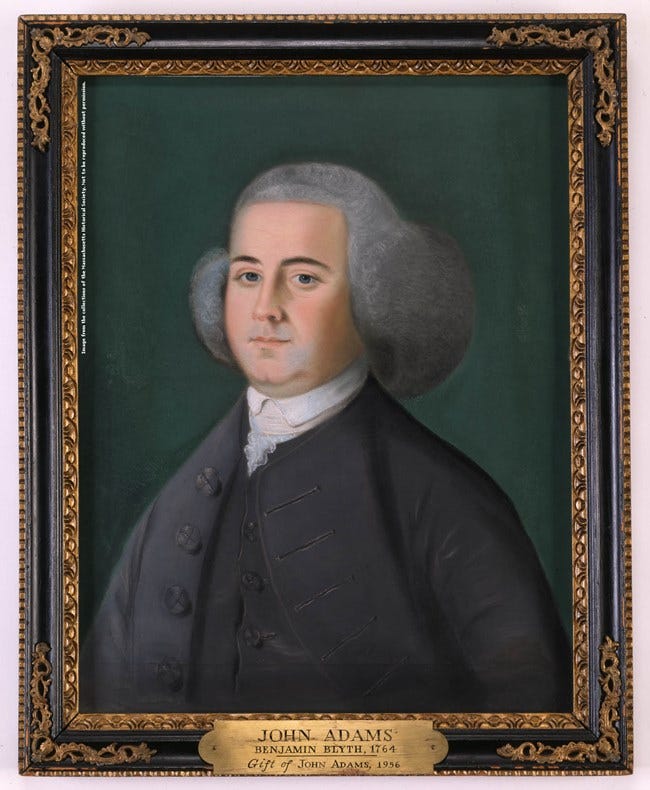
In his autobiography, Adams recalled his reply to Forrest’s plea, saying:
I had no hesitation in answering that Council ought to be the very last thing that an accused Person should want in a free Country … And that Persons whose Lives were at Stake ought to have the Council they preferred … and that every Lawyer must hold himself responsible not only to his Country, but to the highest and most infallible of all Trybunals for the Part he should Act.
John Adams firmly believed that everyone had the right to a lawyer and a fair trial, so he willingly agreed to represent the soldiers even if it meant risking his reputation.
The Court scheduled Preston’s trial first as it would influence the court case against the other soldiers. If the jury found Preston guilty of ordering his soldiers to fire into the crowd, then the soldiers under his command would have only been following orders. If, however, the jury found that Captain Preston had not given the order to fire, the soldiers would be charged with murder and put on trial themselves.
The Trial of Captain Preston
Captain Preston’s trial began on October 24, 1770. Lasting six days, this trial became the first in the American colonies with a duration longer than a single day. The prosecution argued that while Preston had not fired a single shot himself, if he had given the order to fire, Preston would have to take responsibility for the five civilian deaths. The defense argued that there was not sufficient evidence to prove that Preston had given the fatal order. Lacking physical evidence, both the prosecution and defense had to rely almost entirely on eye-witness testimony.
As witnesses gave their testimonies, contradictions emerged. Some witnesses even disagreed over what Preston had been wearing. The contrary evidence made these witnesses seem less credible, which helped to sow seeds of doubt in the jury. The testimonies that ultimately saved Preston were from multiple witnesses who swore that they had seen the captain standing in front of the soldiers when they began to fire.
One of these witnesses was a free Black man, Newton Prince. Prince testified that he saw Captain Preston standing in front of the soldiers and “heard no orders given to fire.” If Preston had indeed given the order, he surely would have been wise enough to stand behind his soldiers.
On October 30, 1770, the jury delivered its verdict: Captain Thomas Preston was found not guilty.
The Trial of the Soldiers
On November 27, nearly a month after Preston’s acquittal, the court moved forward with its trial of the soldiers. Since the prosecution had been unable to prove that Captain Preston had given the order to fire, the question remained: did the soldiers open fire of their own accord? John Adams and Josiah Quincy stayed on the case, while Sampson Salter Blowers replaced Robert Auchmuty. For the trial of the soldiers, John Adams agreed to serve as the lead defense lawyer. The prosecution team, Robert Treat Paine and Samuel Quincy, remained the same.
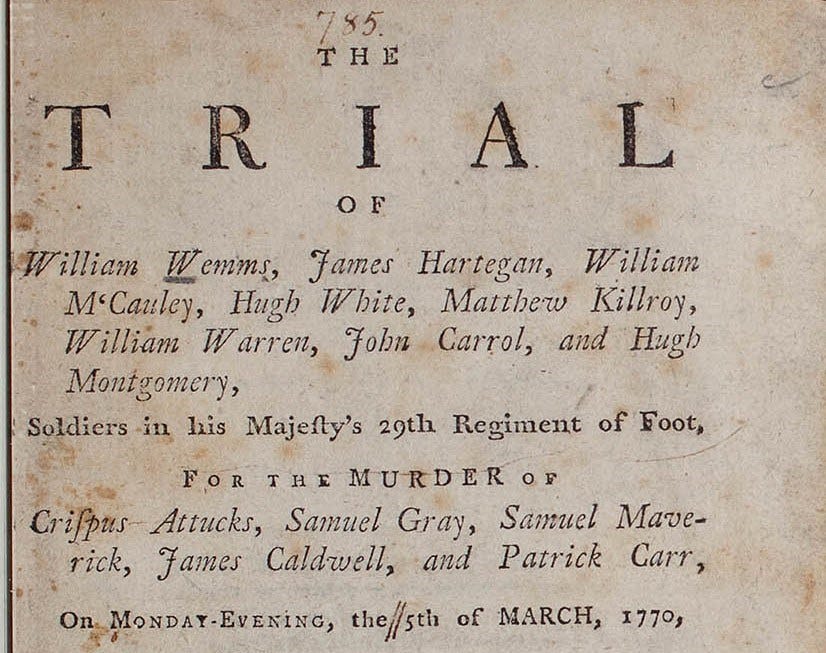
From the beginning of the trial, neither side contested that one or more of the soldiers had discharged their weapons on that fateful night. To argue its case, the prosecution simply needed to prove two points: That the soldiers had been present the night of the incident, and that they had fired their muskets. The defense had a larger task ahead of it. The lawyers needed to argue that the soldiers fired in self-defense, which would justify their actions.
During the trial, the lawyers called more than forty witnesses to testify in court. One of the most interesting testimonies presented for the defense was that of Patrick Carr, one of the victims who had died nine days after the Massacre. John Jeffries, Carr’s surgeon, testified on his patient’s behalf, relaying Carr’s dying declaration to the court. Jeffries told the court that:
[Carr] told me...he was a native of Ireland, that he had frequently seen mobs, and soldiers called upon to quell them...he had seen soldiers often fire on the people in Ireland, but had never seen them bear half so much before they fired in his life...
Seemingly, Carr did not blame the soldiers for defending themselves. This testimony proved invaluable.
In their closing arguments, both the prosecution and defense acknowledged that, without a doubt, the soldiers fired their weapons. However, they debated whether the use of deadly force had been justified. In his closing statement for the prosecution, Samuel Quincy argued that the soldiers could have fled the scene if they feared for their lives. Instead, the soldiers chose to use deadly force. Quincy said, “A person cannot justify killing, if he can by any means make his escape.” Therefore, the soldiers should be convicted of murder.
John Adams closed for the defense. He reminded the jury that their decision had to be based on the facts rather than their passions:
I will enlarge no more on the evidence, but submit it to you.—Facts are stubborn things; and whatever may be our wishes, our inclinations, or the dictates of our passions, they cannot alter the state of facts and evidence: nor is the law less stable than the fact; if an assault was made to endanger their lives, the law is clear, they had a right to kill in their own defence; if it was not so severe as to endanger their lives, yet if they were assaulted at all, struck and abused by blows of any sort, by snow-balls, oyster-shells, cinders, clubs, or sticks of any kind; this was a provocation, for which the law reduces the offence of killing, down to manslaughter, in consideration of those passions in our nature, which cannot be eradicated. To your candour and justice I submit the prisoners and their cause.
After a nine-day long trial, the decision rested with the jury. They deliberated for two and a half hours before returning with their verdict. The jury outright acquitted six of the eight soldiers present the night of March 5, 1770. For the remaining two soldiers, Hugh Montgomery and Matthew Kilroy, the jury found them guilty of manslaughter. By invoking the Benefit of Clergy, an antiquated piece of English law that reduced sentences for first time offenders and could only be used by literate citizens, the defense successfully commuted their sentences from capital punishment to having their right thumbs branded.
Aftermath
Years later, in 1786, John Adams remarked that the Boston Massacre laid the foundation for American Independence. However, the trials held after the Massacre arguably proved to be just as influential.
In the short term, the Boston Massacre trials in 1770 demonstrated to Great Britain that the American colonies could hold fair and just trials and justice could be served locally and administrated by one’s peers. Despite this proof, in 1774, British Parliament passed the Administration of Justice Act, which prohibited the American colonies from conducting or deliberating in their own trials. Parliament passed this act as retribution for the Boston Tea Party, and it fomented further colonial mistrust of British leadership, escalating the already rising tensions that led to the American Revolution.
Beyond the War for Independence, these trials left a lasting legacy. The United States Constitution reflects John Adams’ firm belief that every individual deserves the right to a fair trial. The Sixth Amendment of the Constitution states:
In all criminal prosecutions, the accused shall enjoy the right to a speedy and public trial, by an impartial jury of the State and district wherein the crime shall have been committed, which district shall have been previously ascertained by law, and to be informed of the nature and cause of the accusation; to be confronted with the witnesses against him; to have compulsory process for obtaining witnesses in his favor, and to have the Assistance of Counsel for his defence.
This right has shaped and continues to shape the nation’s legal system.
John Adams’ notes during the Boston Massacre trial shine a light on how he viewed his duty as a lawyer, a view that has influenced subsequent generations’ pursuits of truth and justice in the United States.
It has become my duty, it shall therefore be my endeavor, to acquit myself in the course of this trial with decency and candour; reflecting that however interesting the question may be, the object of our enquiry is simply that of truth, and that this enquiry is to be conducted by the wisdom of the laws and constitution.
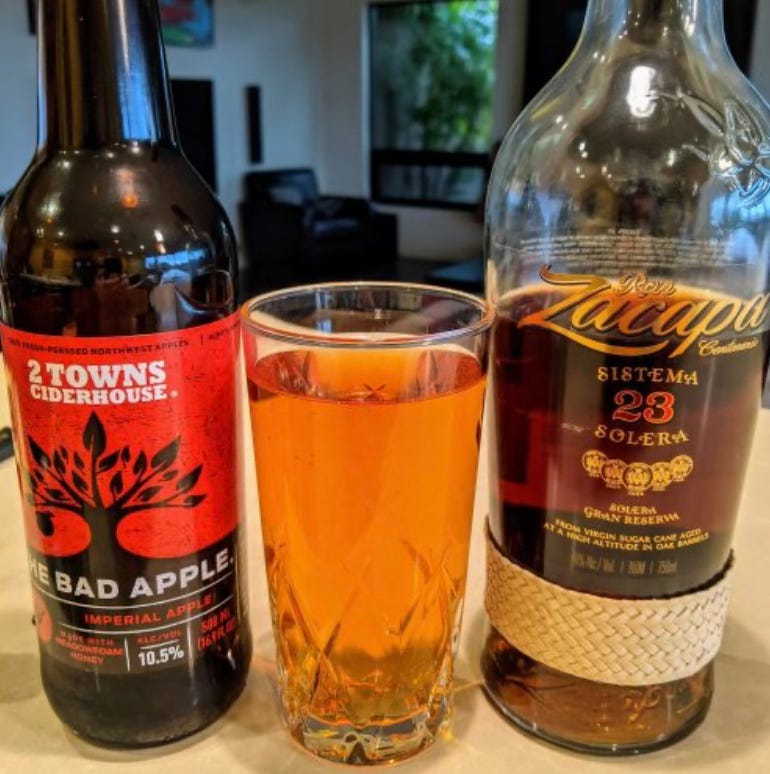
With John Adams’ idea of justice in mind, we give you today’ Drink Of The Day, a Stone Fence cocktail.
Ingredients
Here’s what you’re going to need for this drink:
