
DOTD For Thursday, May 14, 2026
Major High Stakes Diplomatic Missions Deserve A Drink - Like This One
Today’s DOTD - Drink Of The Day - is a Japanese Cocktail inspired by the first Japanese Diplomatic Delegation to the U.S., which officially arrived on May 14, 1860.
Ambassadors of Exchange:
The 1860 Japanese Mission to the U.S.
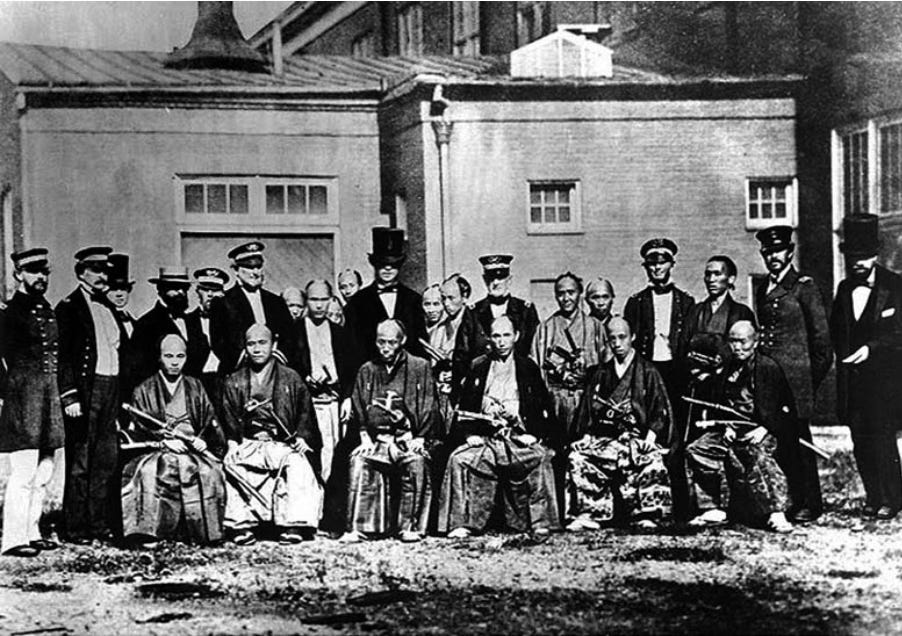
The 1860 Japanese delegation to the United States and host escorts. From the United States National Archives and Records Administration.
The 1860 expedition of the first Japanese ambassadorial delegation to the U.S. was a major event, in its time. While the official purpose of the mission was to ratify the 1858 Treaty of Amity and Commerce, the Japanese entourage became the rock stars of their day in the U.S., surrounded by the press, approached unabashedly by girls and women, and feted by a whirlwind round of parties and special events.
To say it was a special event would be significantly understating it.
Some Historical Context - A Change From The Past
Prior to Commodore Matthew Perry’s forceful arrival in Japan in 1853, the Japanese had not been prepared to open their country to foreign commerce. Frightened by the opium wars perpetrated by foreigners on China, the Japanese had closed themselves off to much of the world for the previous 200 years. So when they finally acquiesced to American demands for trade & diplomatic relations, and signed the Treaty of Amity and Commerce on July 29, 1858, it was a huge change for the Japanese people.
Since Japan was just “opened” to the West in 1854, the 1860 expedition established the first formal commercial trade exchanges with the U.S. which made it a landmark in U.S.-Japanese trade and social relations.
The 1858 Treaty of Amity and Commerce (the Harris Treaty) between the United States and Japan ended Japan’s seclusion policy, and opened several major Japanese ports to U.S. trade: Kanagawa (Yokohama), Nagasaki, Niigata, and Hyogo (Kobe). It also opened Edo (Tokyo) and Osaka as places Americans were allowed to reside in Japan. The treaty also included a fixed, low-duty tariff structure, which prevented Japan from implementing its own trade protections.
The treaty also allowed the official exchange of diplomatic agents, and it included rules of extraterritoriality, meaning that American citizens were exempt from Japanese law, but would be tried for any crimes they committed in Japan by their own consular courts.
Finally, the Harris Treaty also initiated the Ansei Treaties, a series of unequal treaties that would be signed between Japan’s Tokugawa Shogunate and five Western powers—the U.S., Britain, Russia, the Netherlands, and France. These forced agreements angered many in Japan, leading to political violence, and the assassination of multiple Japanese officials. Eventually, these agreements fueled the downfall of the Tokugawa Shogunate and set the stage for the Meiji Restoration.
Diplomacy Among Nations In Transition
The 1860 Japanese diplomatic visit to the U.S. occurred at the cusp between the Tokugawa period (1603–1868) and the Meiji period (1868–1912) in Japanese history, and the Japanese diplomatic visit to the U.S. provided a glimpse of the Japanese nation in transition. They were a people eager to learn about new technologies & foreign cultures, but also distressed by such American social customs as the inclusion of women in important matters and the lack of attention to hierarchy and status.
The delegation, led by three ambassadorial samurai, was sent to ratify the treaty that formally established commercial ties with the U.S. Though forced by previous engagements and treaties, the mission was also part of a final attempt by the Tokugawa shogunate to impress the Japanese people with the government’s modernity. The Tokugawa shogun, losing political power at home and virtually invisible abroad, sent this delegation to the U.S. in an attempt to present Japan in an impressive light to the growing world power the United States was becoming.
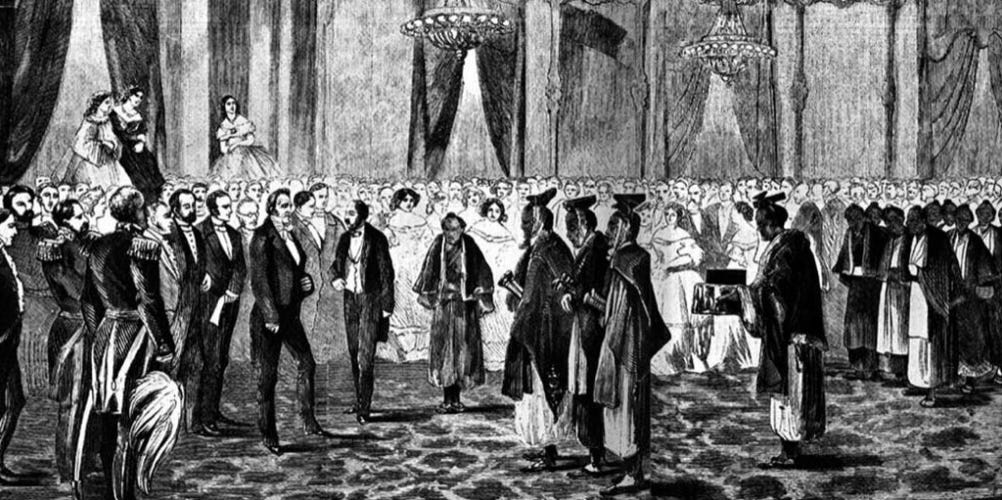
Traveling to the U.S. on an American ship, the coterie of seventy-seven Japanese citizens came with more than fifty tons of baggage, much of it special gifts to cement the new relationship, although some of the baggage contained special Japanese food to sustain the delegation members while they were away from home. While the delegation didn’t include officials of the very highest rank, the sheer numbers of individuals and the array of presents they brought were designed to impress their American hosts.
This meeting of nations also happened at the same time political upheaval was approaching in Japan, and at the same time the U.S. was headed inexorably toward a civil war. Thus, the foreign dignitaries provided a welcome respite from the otherwise mostly grim national news.
While today Americans are relatively blasé about visits of foreign dignitaries, attitudes in the mid-nineteenth century were quite different. Looking back, the excitement surrounding this event was considerable. The visitors began in San Francisco, followed by important governmental ceremonies in Washington, DC. Then they traveled to New York, where they were feted by a ticker tape parade down Broadway, an event now generally reserved, except for holidays, for local sports teams that win major competitions. Even Wikipedia, which lists major ticker tape parades in New York, includes only three in the nineteenth century and three so far in the twenty-first century. Though it may be difficult to fathom such excitement over a diplomatic event, the arrival of the mission captured not only media attention, but also the attention and popular imagination of many Americans as well.

The arrival in the U.S. in 1860 of the Japanese diplomatic delegation indicated that the Japanese government had finally realized their previous isolationism had been more damaging than helpful. Later, in 1871, the Iwakura Mission was sent to the U.S. to bring back scientific ideas to Japan. In between these two missions, the Tokugawa shogunate was overthrown, and the Meiji Restoration indicated a willing interest in new ideas. From this, we can begin to trace the rapid trajectory of Japan’s embrace of Western technology and its march toward modernity. The 1860 delegation was thus a precursor to major social, scientific, and political change in Japan.
It was a change worth celebrating, though. So let’s do so with today’s Drink Of The Day, a Japanese Cocktail!
Ingredients
Here’s what you’re going to need for this drink:
