
Today’s DOTD - Drink Of The Day - is a Nice Bitter Toast Cocktail inspired by the first commercial sale of sliced bread that was sliced by the first whole-loaf bread slicing machine! That happened on this date, July 7, 1928, 98 years ago today.
“Now that’s the best thing since sliced bread!”
Most people are familiar with the decades-old expression above, but few can name the man who invented the bread-slicing machine that gave the world packaged, sliced bread in the 1920s.
The inventor of this ingenious device was Iowa native Otto Frederick Rohwedder, born July 6, 1880, in Des Moines. He grew up in Davenport, Iowa, and out of high school, became an apprentice to a jeweler to learn a trade. After apprenticing as a jeweler for two years, he changed the direction of his career, entering the Northern Illinois College of Ophthalmology and Otology in Chicago, from which he received a degree in optics in 1900.
But Rohwedder would go back to jewelry, and in 1905, marrying and settling in St. Joseph, Missouri. Over the next eleven years, Rohwedder would come to own three jewelry stores in St. Joseph, where he would use his work with watches and jewelry to invent new machines.
Around 1912, he would come up with the idea for a bread slicer that would automatically cut loaves of bread into slices for consumers. He worked on several prototypes, including one that held a sliced loaf together with metal pins though these early models would prove unsuccessful.
By 1916, convinced he could develop an automatic bread slicing machine, Rohwedder sold his jewelry stores, and moved back to his hometown of Davenport, so he could fund the development effort and manufacture the machines
His biggest challenge came in late 1917 when a fire destroyed Rohwedder’s design blueprints at a Monmouth, Illinois, factory that had agreed to build his first slicing devices. It would take several years for him to recoup his losses, but Rohwedder continued to make refinements to his design, even as he was working as an investment and security agent. In the course of his research, he realized that he would need to find a way to prevent a loaf of sliced bread from going stale. By 1927, he had devised a solution to this problem: a machine that would slice the bread – and also wrap it.
At just about this time, in 1926, the pop-up toaster was just beginning to catch on in American households. This helped give Rohwedder just the boost he needed to get his latest version of the bread slicer off the ground. He filed for a patent on his new slicing-and-wrapping device (U.S. Patent No. 1,867,377 was issued to him on July 12, 1932) and sold his first machine to the Chillicothe Baking Company, in Chillicothe, Mo., in 1928. On July 7 of that year, the company sold its first loaf of sliced bread. Customers loved the product, which Chillicothe Baking Co. dubbed Kleen Maid Sliced Bread. Demand climbed swiftly; within a year, Rohwedder found himself scrambling to keep up with the pace of requests he was getting from bakeries to supply his slicing machines. Within 5 years, 80% of bread sold in the U.S. would be pre-sliced.
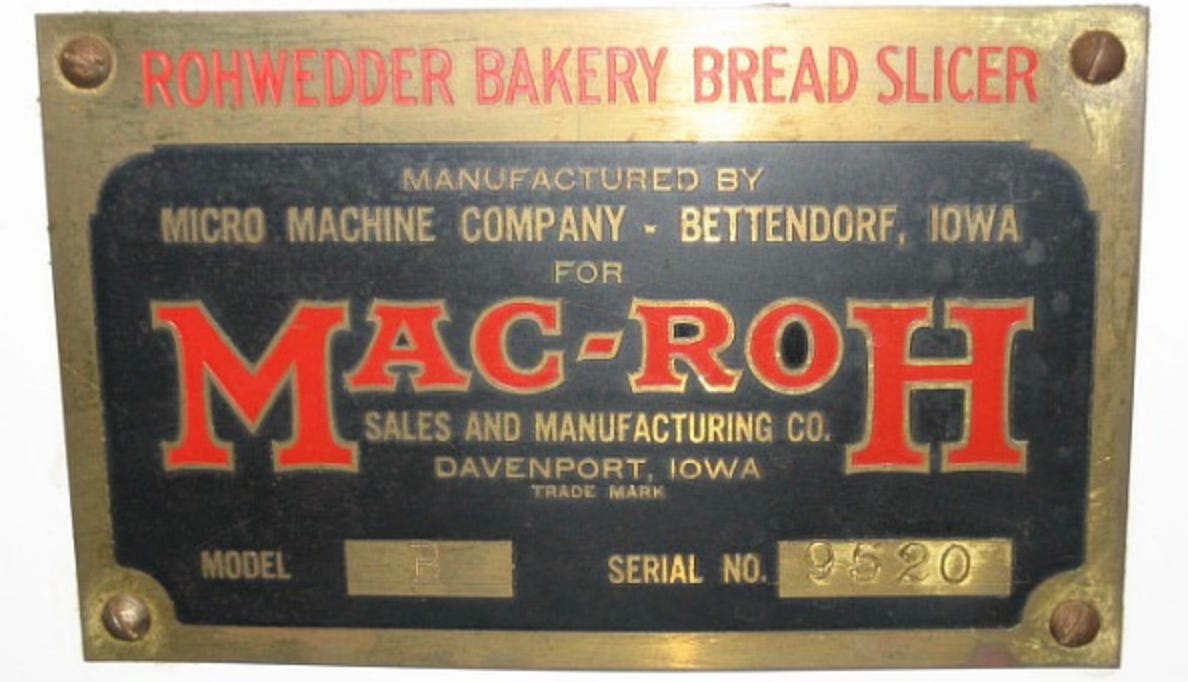
In 1929, just as he was getting his Davenport-based Mac-Roh Sales and Manufacturing Company up and running, the Great Depression hit, and Rohwedder was forced to sell rights to his invention. Micro-Westco Co. of Bettendorf, Iowa, purchased the rights, and the machines, and hired Rohwedder to serve as a vice president and sales manager within its newly formed “Rohwedder Bakery Machine Division.”

Sliced bread became more and more popular, and sales began skyrocketing nationally, beginning in 1930 when Wonder Bread began marketing and promoting sliced bread using its own specially designed equipment. By 1933, bakeries were selling more sliced bread than unsliced bread.
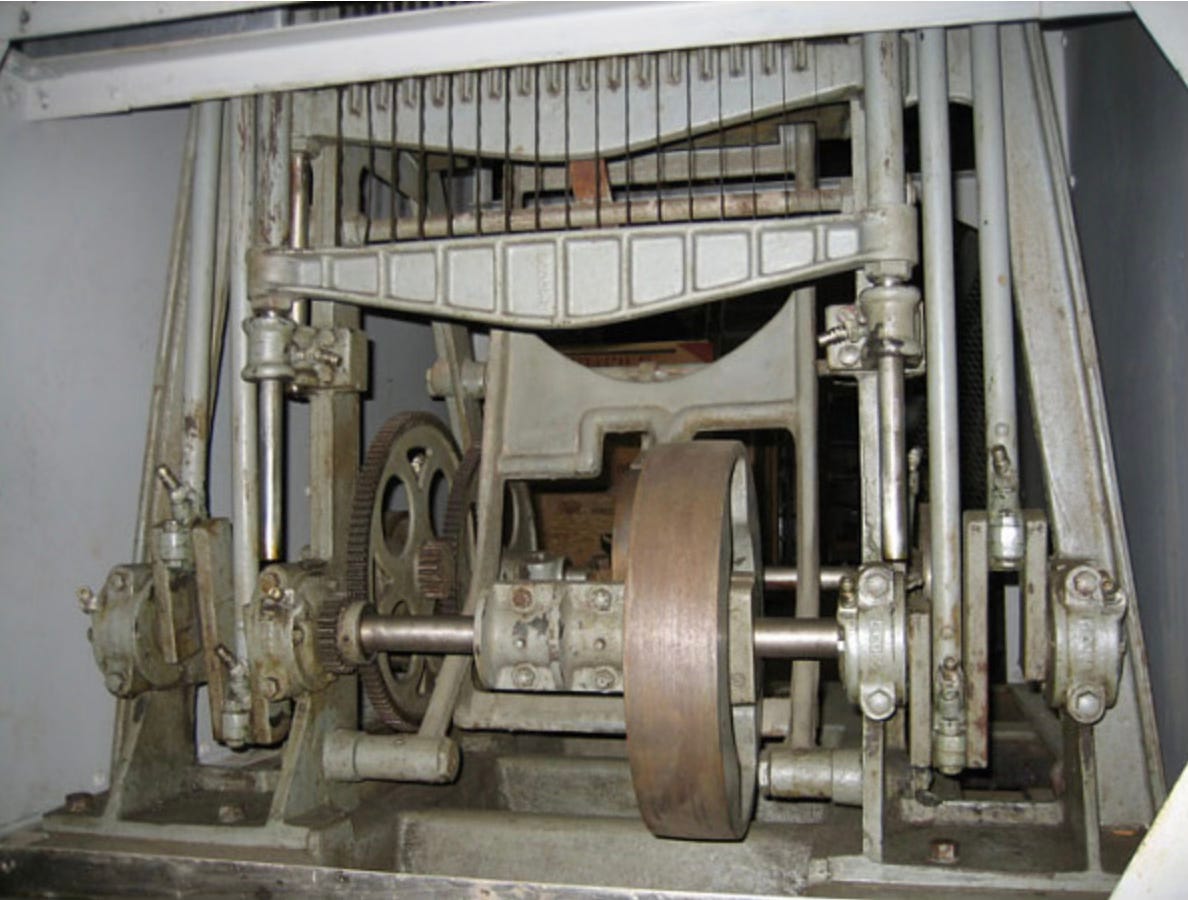
Rohwedder, meanwhile, had become known as the “father of sliced bread,” and was invited to speak to groups around the country. He died in Concord, Mich., on Nov. 8, 1960. One of the first models of his original slicing machine is now housed at the Smithsonian Museum of American History in Washington, D.C., as you can see near the top of this page.
So as a salute to Otto Rohwedder, let’s toast with today’s Drink Of The Day – a Nice Bitter Toast Cocktail!
Ingredients
Here’s what you’re going to need for this drink:
