
DOTD For Tuesday, June 16, 2026
This Drink's All About Haulin' Ass - Literally
Today’s DOTD - Drink Of The Day - is a White Water Ride Cocktail inspired by what’s considered to be America's first intentionally constructed roller coaster, the Thompson Switchback Coaster, which opened for business for the first time on this date, June 16, 1884 at Coney Island in Brooklyn, New York
Inspiration: Haulin’ Coal - & Haulin’ Ass Too
In 1827, the Mauch Chunk and Summit Railroad - also known as the Mauch Chunk Switchback Railway - was the second permanent railroad constructed in the United States and the first over five miles long. It was never intended to become a tourist attraction. It was built by the Lehigh Coal & Navigation Company to carry coal out of rugged mountain mines located along a nine mile stretch in Eastern Pennsylvania. The rail line was not only constructed to carry coal down the mountainside, but also carry miners up, to help them return to their homes.
While primarily gravity powered, like its rival the B&O Railroad, the Mauch Chunk at first partially used animal power. Mules & asses hauled the empty coal tubs to the summit and then were sent down in the last batch of cars; the return trip required 4–5 hours. Crews would send down groups of 6–8 coal cars under control of a brakeman, and once 40–42 cars were down, send down the special “mule cars” with the animals, thus having just enough animals to return all the cars back to the top. In 1846, animal power was replaced by two two steam-powered funicular systems to haul the cars uphill, but travel downhill continued to rely on the power of gravity.
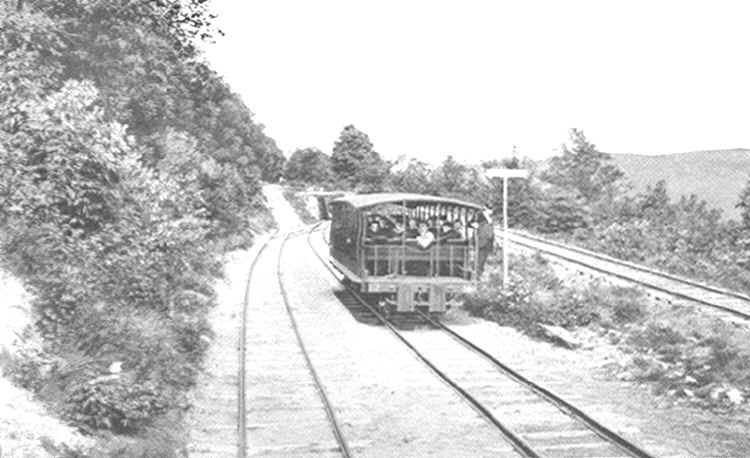
A more efficient rail line was built in 1872 and the Mauch rail line was purchased by the Central Railroad of New Jersey (CNJ) in 1874. Seeing the commercial value of offering rides to the general public, 19th-century entrepreneurs Theodore and H.L. Mumford leased the rail line from the CNJ and began operating the railway as a tourist attraction until the Great Depression forced its closure in 1932.
Considered to be America’s first roller coaster “thrill” ride, the Mauch Rail Line began taking on passengers in 1874 and was an immediate success. Passengers would board at a station in Mauch Chunk (now called “Jim Thorpe”) before ascending 664 feet to the top of the Mount Pisgah incline, and then pass an engine house at the top of the incline before traveling down by gravity along five miles to the foot of the Mount Jefferson incline, where they would travel back upwards before plummeting once again. On long stretches of straight track, the cars were reported to reach speeds exceeding fifty miles per hour.
A talented young inventor rode the Mauch line, and it changed both his life and the path of American entertainment. That young man’s name was LaMarcus Adna Thompson. Born in Licking County, Ohio on March 1, 1848, Thompson is often referred to as “the Father of the Modern American Roller Coaster”. Throughout his lifetime, he held over thirty patents relating to roller coaster technology.
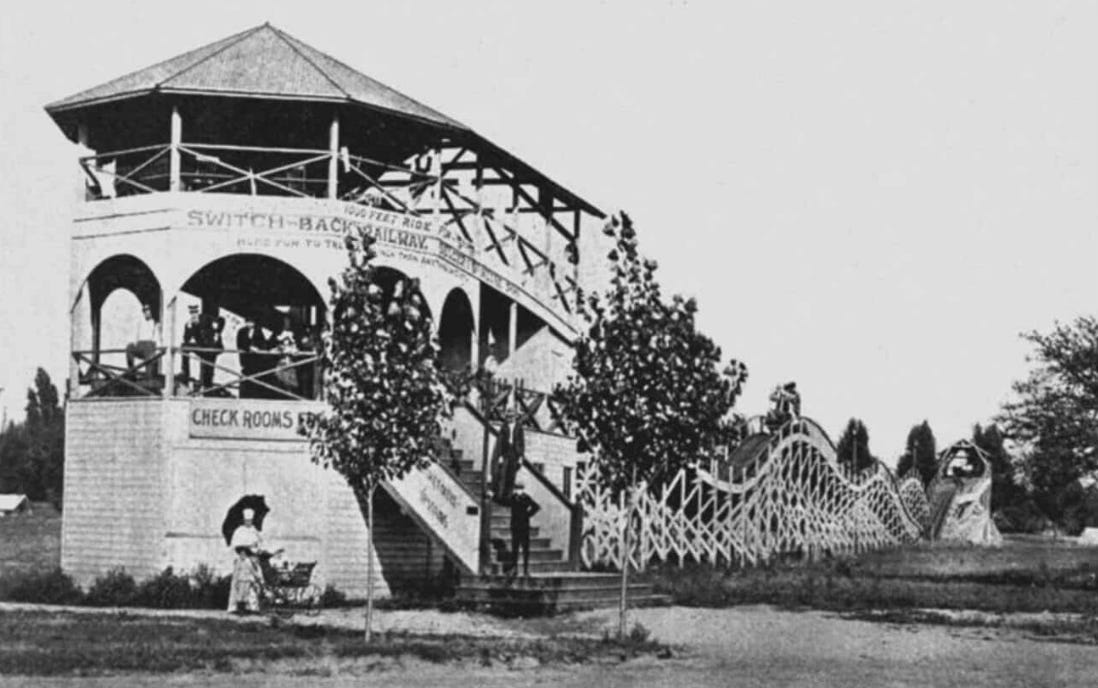
By John Frato, Carousel Operations Coordinator, Cleveland History Center
America’s First Intentionally Constructed Roller Coaster
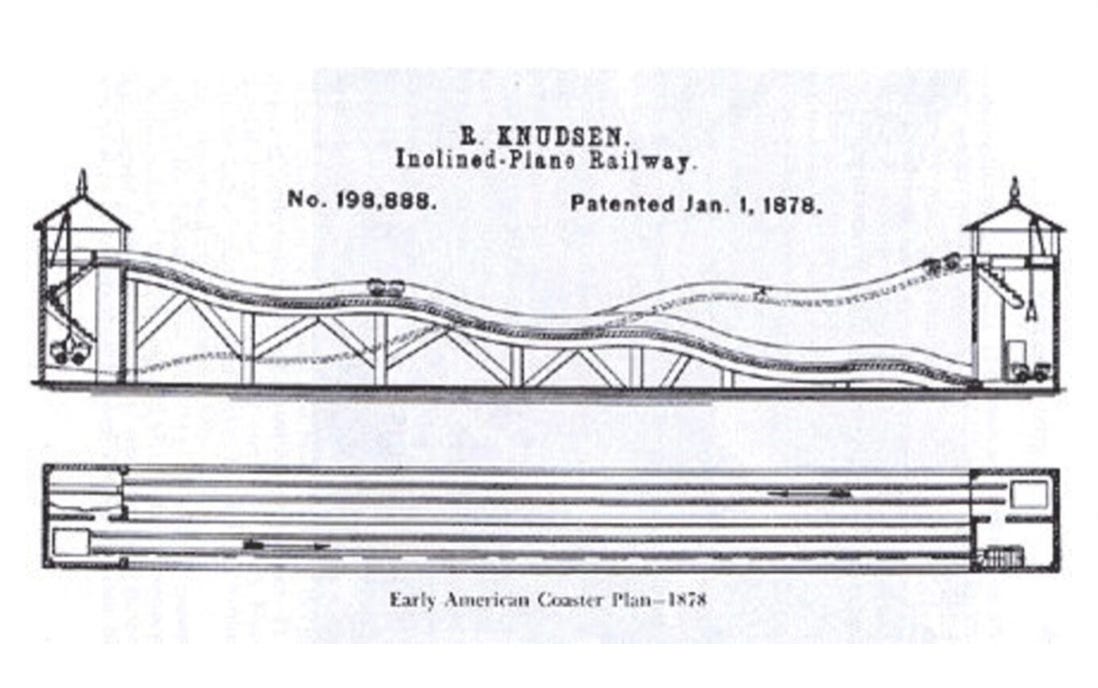
It was no coincidence that the attraction in Coney Island was also called “Switchback Railway” - its designer, LaMarcus Adna Thompson admitted that he based his design, at least in part, on the popular railway ride in Pennsylvania. Thompson was also working off of another inventor’s patent that was filed in 1878. That other inventor, Richard Knudson, called his version of a gravity roller coaster the “Inclined Plane Railway” and it is strikingly similar to Thompson’s final design.
Thompson’s original “Switchback Railway” ride debuted at Coney Island on June 16, 1884, and holds the distinction of being the first roller coaster type ride designed and built for the purpose of amusement rather than an existing rail line converted for that purpose. The ride consisted of two sets of parallel tracks descending in opposite directions from elevated towers. To complete their round trip, riders had to get out of their cars after they came to a stop and ascend a second fifty foot tower to board cars to head back.
The novelty of the new ride far surpassed any problems riders had with exiting their cars, re-boarding, or climbing the second set of stairs to the top of the tower to return. Initially riders were not seated directly in front of one another as they are on modern roller coasters, but were seated in benches parallel with the track facing outward. Even with all of its shortcomings, the ride was immensely popular and reportedly paid for itself during its first month of operation.
The original cost for the heart pounding six mile per hour ride that lasted one minute was five cents. Thompson’s later rides were often referred to as “Scenic Railways” since they gave riders a panoramic view of the landscape as they traversed the tracks from one end to the other. His later designs had elaborate backgrounds of exotic foreign locales painted along the length of the tracks. The immense popularity of the new ride led to the formation of the L. A. Thompson Scenic Railway Company that oversaw the construction of rides across the country. Given Thompson’s home state was Ohio, it should come as no surprise that when rides were first added to Euclid Beach, Ohio in 1896, a LaMarcus Thompson Gravity Roller Coaster was their choice.
The Switchback Railway at Euclid Beach had a little over one thousand feet of track. Riders climbed stairs to the top of the tower where they boarded a car that was manually pushed out of the loading platform and hopefully gravity took the passengers to the opposite end of the tracks where the other tower was located. There they would disembark and the ride operators would push the car up to the loading platform in that tower. Once they were again seated, they would be pushed out onto the track for the return trip to the first tower…a truly exhausting amount of labor for a six mile per hour trip. The ride was dismantled and removed from the Park when the Figure Eight ride was installed in 1904.
The big question some folks may have is… Can you still ride a Switchback Railway today? The answer is sadly, no - but you could as recently as August 205.
A modern version of the switchback coaster opened at a small amusement park located between San Antonio and Austin Texas in the small town of Seguin, Texas in 2015.
“The Famous Switchback Railway “ as it was called, was designed by the Ohio-based Gravity Group for the Texas ZDT Amusement Park and was the first new wooden “shuttle coaster” built anywhere in the world in more than a century. Here’s a first person example of what it was like to ride this unique coaster:
Like the old Switchback at Euclid Beach Ohio, it reverses course mid-way. However, unlike the ride at Euclid Beach it retraces its way back to the loading station backwards rather than forward. The \new Switchback began with a sixty three foot tall lift hill rather than a friendly push by Park employees, reached speeds up to forty five miles per hour, and ascended a sixty four foot tower before rocketing back to the station along 1,980 feet of track (actually only about 1,000 feet of track but you travel it twice). A brake run at the bottom of the lift hill along with a section of switch track allowed the coaster to safely operate two trains.

Rising operational costs forced ZDT’s Texas Amusement Park to close its doors permanently on August 17, 2025. Following the closure, the Switchback coaster was placed on the market by International Rides Management so it could potentially be relocated to a new theme park.
While the Switchback ride may be gone now, the evolution of roller coasters began with that ride - and that’s worth raising a glass to, in our book.
Ingredients
Here’s what you’re going to need for this drink:
