
Today’s DOTD - Drink Of The Day - is a Joy Division Cocktail inspired by World Photography Day! For those who say, “What does an early post-punk band - Joy Division - have to do with photography?” Rock historians consider the band’s use of visual imagery, unique press portraits, & iconic album art to be one of the groups that helped open the worlds of rock & pop music to visual ideas that would explode in the decade after the band ended.
Origin of World Photography Day
The idea of a global day to celebrate photography was originally proposed by photography teacher O.P. Sharma of India in 1988. He pursued the idea, reaching out to different photography groups to coordinate, and as a result of his hard work, the first observance of World Photography Day happened in 1991. For a number of years, World Photography Day primarily consisted of in-person events held around India, and then slowly began to grow from there. World Photography Day first began to trend in a significant way online in August 2005. Starting in 2010, it was promoted for a time online as “World Photo Day” by entrepreneur Korske Ara of Australia, where interest in the concept continued to grow. Producer John Morzen of North America joined the effort, and through his work, oversight, and diligence over the last decade, World Photography Day has grown to how it is recognized and celebrated today. Now, every World Photography Day is marked annually around the world with events, workshops, photo walks, and most importantly, people sharing their photography and what it means to them!
A Brief History of The Origin Of Photography
Louis Daguerre was born on November 18, 1787, in Cormeilles-en-Parisis, France. His family was middle-class, though he grew up during a time of great political upheaval with the turmoil that was the French Revolution. The revolution involved the common working & poor people versus the rich bourgeoisie aristocrats. The poor wanted to improve their standard of living, and the ruling class wanted to hold onto their cheap labor & severe socioeconomic separation, that was made possible by King Louis XVI’s right-wing economic policies of pervasive economic inequality, severe debt spending, and large-scale deregulation. When the people could no longer withstand the oppression of the rich, the revolution exploded.
Historically, these kinds of events often spur young artists to create work that encapsulates the tumult of their era, and it did for young Daguerre as well, in the form of drawing.
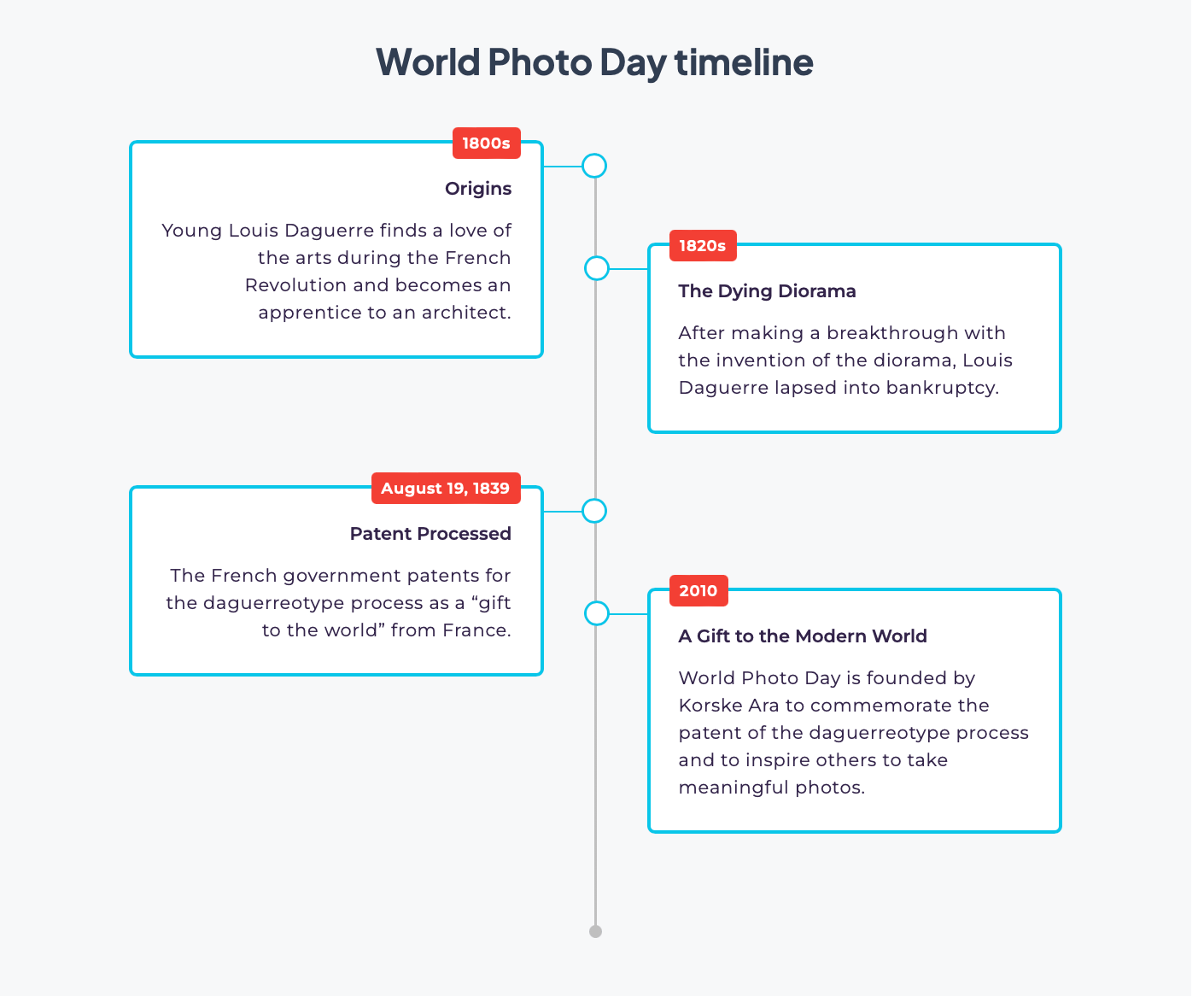
Despite having a limited formal education, Daguerre was a natural artist. At the age of 13, he became apprenticed to an architect where he learned hands-on the mechanics of the art and the science of designing structures. This created the foundation for his understanding of how objects were built. Within a few years, Daguerre moved to Paris to apprentice in architecture, theatre design, and panoramic painting with Pierre Prévost, the first French panorama painter. Exceedingly adept at his skill of theatrical illusion, Daguerre would become a celebrated designer for the theatre, and later came to co-invent the diorama theatre with painter Charles Marie Bouton.
In the spring of 1821, Daguerre partnered with Bouton with the common goal of creating a unique kind theatrical experience. Daguerre had expertise in lighting and scenic effects, and Bouton was the more experienced painter. To create their newly named ‘diorama theatre’ the two men would take a large translucent canvas, measuring around 70 ft wide and 45 ft tall, and paint it on both sides. These paintings were vivid and detailed pictures, and were lit from different angles. The audience would first see one image, and then as the lights changed, the scene would transform, and they’d begin to see the painting on the other side of the screen.
At the same time Daguerre was inventing a new type of theatre, he was also involved in exploring photography
In 1829, Daguerre struck a partnership with fellow inventor Joseph-Nicephore Niépce to develop a method to permanently capture the fleeting images visible in a camera obscura. Niépce passed away suddenly in 1833, but Daguerre kept experimenting, finally achieving success around 1834. The process he used became known as daguerreotype. It used a polished sheet of silver-plated copper, treated with iodine to make it light-sensitive, which was exposed to an image under a lens, for several minutes or more; then that image was “fixed” to the polished sheet, using mercury vapor.
The existence of the process was first announced to the public in January of 1839—followed by an extraordinary move by the French government that would fuel the rapid growth of photography worldwide. Recognizing the enormous potential of this invention, the French government made a deal with Daguerre, acquiring the rights to the process in exchange for lifetime pensions for both Daguerre and Niépce’s son. Then the French government gave it all away. On August 19, 1839, the details of the new daguerreotype process were presented to the public as a gift to the world from France.
World Photography Day FAQs
Why is World Photography Day celebrated on August 19?
World Photo Day is celebrated on August 19 to commemorate the day in 1839 when the French government purchased the patent for the daguerreotype process. This invention, a groundbreaking photographic method, was then presented to the world as a free gift.
How many photos are taken each year?
Estimates suggest that over 1.8 trillion photos are taken globally each year, with the vast majority now captured on smartphones. This staggering number highlights photography’s pervasive role in modern communication and personal memory-keeping.
What is the origin of the word ‘photography’?
The word ‘photography’ was coined by British scientist Sir John Herschel in 1839. It comes from the Greek words ‘phōtós’ (light) and ‘graphê’ (drawing or writing), literally meaning ‘drawing with light.’
How To Celebrate World Photography Day
Take a photo of your world
World Photo Day is supposed to be about capturing your world. Take some time and really think about what exemplifies your world. Perhaps it’s something you’ve created with your hands or the love you have for your pet. Art is subjective so don’t be afraid to color outside the lines.
Learn about a famous photographer
There are so many photographers that have produced some of the most beautiful images in the world. Richard Avedon, Dorothea Lange, Gordon Parks, Ansel Adams, Annie Leibovitz, James Van Der Zee, and Robert Frank are just some of the names who have shown their expert talents with photography. Research a photographer that moves you and learn more about their history, work, & style.
Social media blitz
If you’re more of an appreciator of photos, you can check out the hashtag #WorldPhotoDay today and see the photos your fellow global citizens have taken. When you come across photos that move you, share them, as you credit & compliment the photographer. It’ll be sure to brighten their day.
5 Amazing Facts About World Photography Day
Moonshot
The first photo of the moon was taken in 1851.
Let them take pictures
Daguerre’s father named one of his daughters Marie Antoinette.
The dancing painter
When Daguerre went to Paris to apprentice, he was also an extra on the stage of Paris’ famed Opera and became known for his dancing skills.
Picture/Victoria
Queen Victoria and Prince Albert had darkrooms installed at their royal residences, including Windsor Castle and Buckingham Palace, that they used to process their own photography.
Letter marked
The earliest known use of the abbreviated word “photo” was from Queen Victoria in an 1860 letter.
Why We Love World Photography Day
Photography is an art form
The art of taking photos isn’t just pointing and clicking. There’s so much that goes into photography that shouldn’t be overlooked. The background, the flash, color, shutter speed, and more all need to come together in just the right way to evoke a truly moving piece of art. Taking a day to really commend all those who have devoted their lives to this craft.

Great photography also helps us appreciate life
A great photographer can make the mundane appear spectacular. Everyday objects can take on a deeper meaning depending on the eye of the photographer. Today’s holiday is a chance to thank all those who see the beauty in unsuspecting things, and capture that beauty to share with the world.
In that spirit, we give you today’s Drink Of The Day, a Joy Division Cocktail
Ingredients
Here’s what you’re going to need for this drink:
